

Please find details of Homage to Picasso’s Dancers by Menashe Kadishman
Discover a colorful and thoughtful piece in Israeli art with Homage to Picasso’s Dancers, an acrylic on canvas painting by Menashe Kadishman. This 109 x 98 cm work brings together simple shapes and strong feelings in an interesting way.
About the Artist
Menashe Kadishman (1932–2015) emerged as a leading Israeli sculptor and painter who blended personal experience with universal themes. Born on 21 August 1932 in Tel Aviv during the British Mandate period, he grew up in an artistic household: his mother Bilha taught and painted, while his father Ben-Zion worked as a sculptor. When his father died in 1947, the fifteen-year-old Kadishman left school to support the family. He began formal training at the Avni Institute in Tel Aviv (1947–1950) under Moshe Sternschuss and Aharon Avni, then continued with Rudi Lehmann in Jerusalem in 1954.
After serving in the Nahal infantry brigade, he spent three formative years as a shepherd on Kibbutz Ma’ayan Baruch. That direct contact with nature and animals later defined his signature motif. In 1959 he moved to London, where he studied at Saint Martin’s School of Art and the Slade School of Art, training alongside Anthony Caro and Reg Butler. He held his first solo exhibition at London’s Grosvenor Gallery in 1965 and returned permanently to Israel in 1972.
Kadishman received major recognition, including the 1995 Israel Prize for Sculpture. Moreover, he represented Israel at the 1978 Venice Biennale with a flock of live sheep whose wool he dyed in bright colours—an unforgettable performance that turned living animals into art.
The Artwork
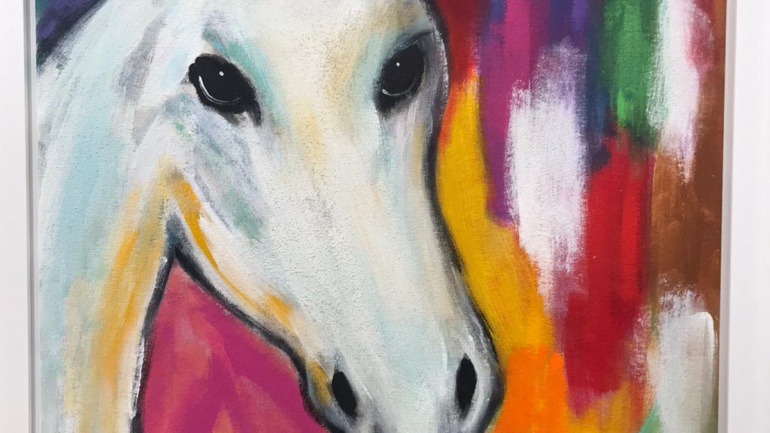
In Homage to Picasso’s Dancers (ca. 1960–1990), Kadishman places a luminous yellow sheep at the centre of the composition. The animal gazes directly at the viewer with large, melancholic black eyes. Surrounding it, fluid black lines trace dancing figures that clearly echo Pablo Picasso’s famous 1925 painting The Three Dancers.
Consequently, Kadishman transforms Picasso’s anguished, distorted human forms into his own iconic sheep. The figures flow softly across a serene purple background, while the bright yellow sheep radiates warmth and presence. Thus, the painting achieves a perfect balance: it pays respectful tribute to Cubist energy yet infuses the scene with Kadishman’s characteristic gentleness and subtle sadness. Furthermore, the sheep motif carries deeper layers—rooted in the artist’s shepherd years and often linked in his oeuvre to themes of innocence, sacrifice, and the memory of fallen soldiers.
Artistic Significance
What makes this work particularly compelling lies in its intelligent dialogue across art history. Kadishman does not simply copy Picasso; he inserts his personal symbolism into a canonical modernist image. In this way, he bridges Israeli post-war art with European avant-garde traditions and invites viewers to reflect on how animals can express complex human emotions. The large scale commands attention, yet the soft lines and harmonious palette make the painting approachable and pleasant in any interior.
Our gallery
This acrylic on canvas is currently offered by Kings Gallery Jerusalem. Kings Gallery is a leading fine art gallery established in Jerusalem in 1995. We strive to collect and sell the highest quality historic and contemporary Israeli and International art. The gallery specializes primarily in artists from the early period of the 1920’s. Besides, Kings Gallery features leading up-and-coming young artists who will definitely be prominent names in the next few years.
Contact Kings Gallery Jerusalem today to discuss availability, pricing, or to arrange a private viewing of this thoughtful piece.