

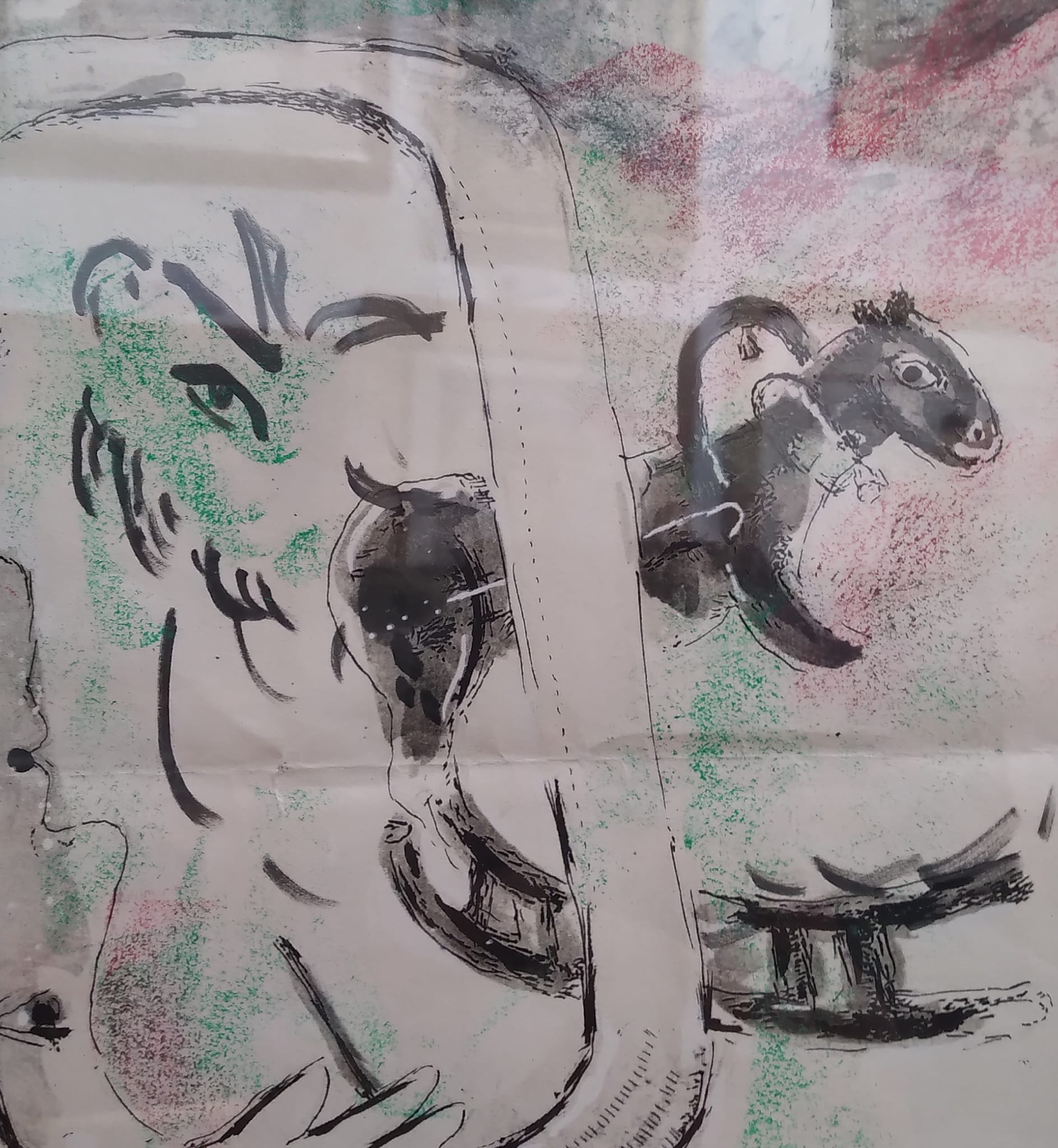
Marc Chagall is one of the most outstanding artists. As he described: “My art does not reason, it is molten lead, the azure of the soul pouring on the canvas”. His Black Horse (mixed media on paper, 30 × 23 cm) presents a refined and introspective meditation on imagination, authorship, and narrative. The work does not depict an external scene but instead visualizes the internal process through which images are formed, observed, and released.
At the center of the composition appears a human figure whose elongated hands create a rectangular frame. This frame does not function as an architectural or pictorial device; it is formed by the figure’s own body. The hands establish a fragile and temporary structure — a space of imagination actively shaped and held by the observer. The figure directs its gaze toward what emerges between the hands, emphasizing that vision here is intentional and inward rather than passive or descriptive.
Signature
The presence of Marc Chagall’s signature in the lower left corner reinforces an authorial reading of the image. The figure may be understood as the artist himself, not in the sense of a literal self-portrait, but as an alter ego — the creator observing the images generated by his own imagination. The hands thus function simultaneously as tools of perception and creation.
Within this framed space, a goat can be discerned, a motif that recurs throughout Chagall’s work and often carries associations with humility, memory, folklore, and biblical tradition.
Frame
In contrast, a horse pulls a cart outward, crossing the boundary formed by the hands. This movement introduces a critical tension within the composition. The horse does not remain fully enclosed by the frame of imagination but seems to emerge from it, suggesting that the images produced by the artist acquire autonomy. The cart reinforces the sense of narrative motion — of images carrying stories, memories, or experiences beyond their point of origin.
The frame, formed by the artist’s hands, proves permeable. It attempts to contain the imagined scene, yet it cannot fully restrain it. Chagall thus presents imagination as a dynamic force: shaped by the artist, yet ultimately resistant to control. Inner images press outward, entering the shared visual space between artist and viewer.
Technique
Chagall’s use of mixed media on paper enhances this sense of immediacy and instability. Ink lines remain open and expressive, while soft washes of color activate the surface without fixing spatial relationships. The modest scale of the work encourages close viewing, aligning the viewer’s experience with the introspective act depicted within the image itself.
Black Horse can be read as a self-reflective work that addresses the act of creation directly. By presenting his own hands as the frame of vision, Chagall collapses the boundary between artist, observer, and image. The work becomes a visual reflection on how imagination operates — held briefly, observed attentively, and ultimately allowed to move beyond the limits of its maker.
Our collection
Kings Gallery is a leading fine art gallery established in Jerusalem in 1995. We strive to collect and sell the highest quality historic and contemporary Israeli and International art. The gallery specializes primarily in artists from the early period of the 1920’s. Besides, Kings Gallery features leading up-and-coming young artists who will definitely be prominent names in the next few years.