
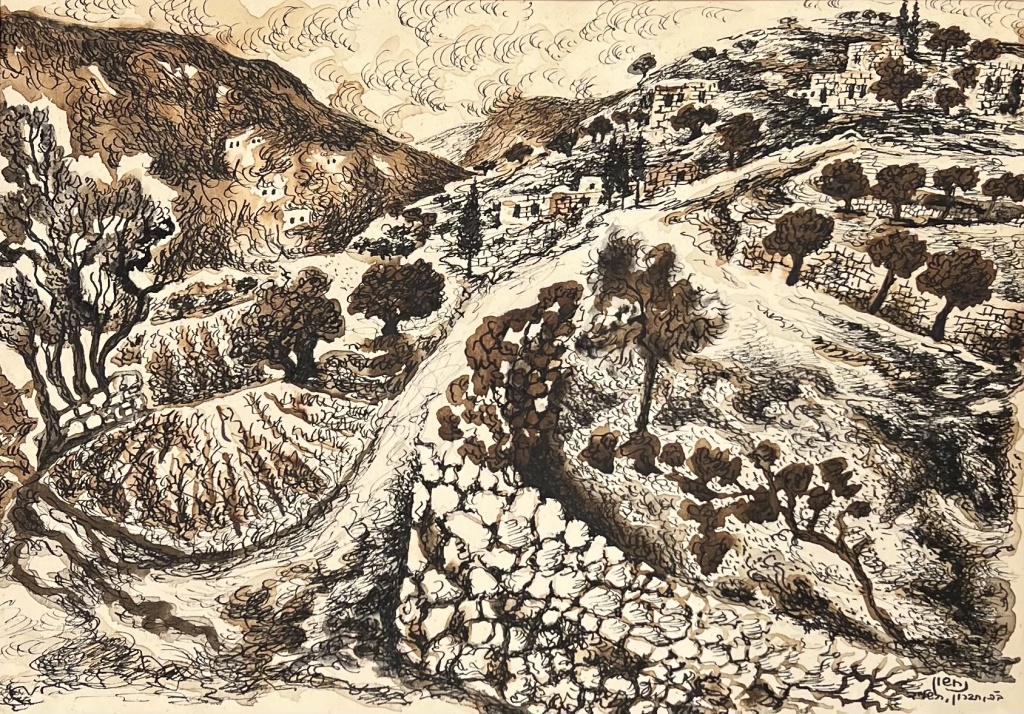
Baruch Nachshon captures the mystical spirit of Hebron in this dynamic composition, where gouache, pen, and coffee blend into a striking vision of the city’s spiritual resonance. Baruch Nachshon’s Hebron (Pen, Gouache and Coffee on Canvas, 33 × 47 cm) is a spiritual meditation rendered in earthy hues, steeped in memory, mysticism, and the sacred energy of the city of the Patriarchs.
From the first glance, this intricate drawing transports the viewer to Hebron’s undulating landscape. Winding stone paths, terraced vineyards, and clusters of olive trees weave through hills crowned with ancient houses. Unlike conventional color palettes, Nachshon uses coffee washes to stain the page with a sepia-toned aura, evoking timelessness and grounding the scene in the soil of the Land of Israel.
The Spiritual Weight of Hebron
Hebron is not merely a city — it is a spiritual epicenter. As the burial place of Abraham, Isaac, Jacob, Sarah, Rebecca, and Leah, the Cave of the Patriarchs (Ma’arat HaMachpelah) imbues the land with an aura of sanctity. For millennia, Jews have revered Hebron as the second holiest city after Jerusalem. This holiness emanates from the very earth, and Baruch Nachshon captures this essence not through grandeur but through humble textures and flowing lines.
Moreover, Hebron is a city where heaven and earth meet. The winding path in the center of the painting can be seen as a metaphor for the spiritual journey — the soul’s ascent through hills and valleys toward divine connection.
A Mystic’s Brush
Nachshon (1939–2021), a devout follower of the Lubavitcher Rebbe, painted not only what he saw, but what he felt — often visions from his own deep prayer and meditation. His art reflects a world beyond the visible: a mystical, divine reality always present, waiting to be revealed.
In Hebron, this inner world is palpable. The wild curls of his ink strokes suggest wind, breath, and divine presence sweeping through the valleys. His use of nontraditional materials like coffee not only enhances texture but also anchors the piece in organic, lived experience — reinforcing that holiness is not abstract, but earthly.
Conclusion
Baruch Nachshon’s Hebron is a visual prayer. It invites us to walk the sacred terrain of our ancestors with reverence, to feel the pulse of the land beneath our feet, and to remember that art can be a vessel of spiritual truth. This is not merely a landscape — it is a sanctuary on canvas.
Our collection
Kings Gallery is a leading fine art gallery established in Jerusalem in 1995. We strive to collect and sell the highest quality historic and contemporary Israeli and International art. The gallery specializes primarily in artists from the early period of the 1920’s. Besides, Kings Gallery features leading up-and-coming young artists who will definitely be prominent names in the next few years.