

Keith Haring (1958–1990) holds a significant place in the history of late twentieth-century American art, particularly in scholarly discussions of urban visual culture, material experimentation, and the expansion of artistic practice beyond traditional formats. The three works selected from presented at King’s Gallery Jerusalem offer a rare opportunity to examine Haring’s approach to non-traditional surfaces while also representing exceptional works available for acquisition.
Suede Jacket

To begin with, the suede jacket drawn during the Montreux Jazz Festival in 1983 exemplifies Haring’s direct engagement with live cultural environments. Rather than treating the jacket as a purely functional garment, Haring transformed it into an active artistic surface. Using black marker, he drew a dynamic figure on the back, closely aligned with his broader interest in movement, rhythm, and performative space. Furthermore, the jacket’s documented origin, combined with the artist’s signature and date, firmly anchors the work within a specific historical moment. The accompanying certification agreement issued by the Keith Haring Foundation further reinforces its authenticity and market significance. It is a rare collectible that intersects art history and wearable art.
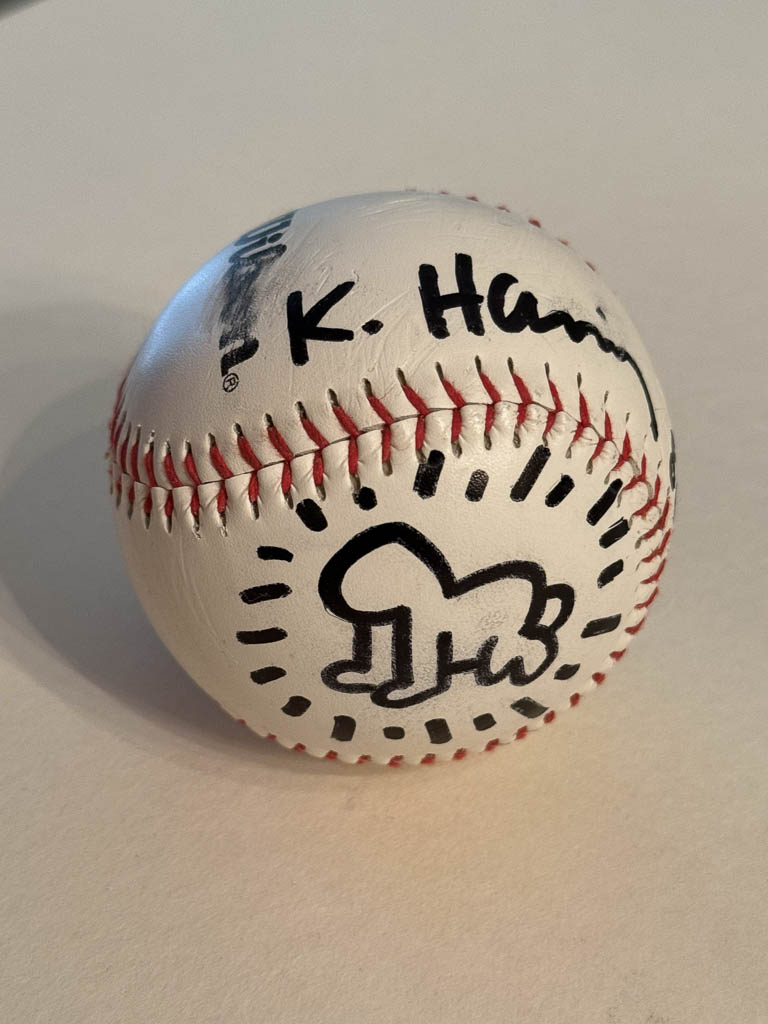
Baseball
In contrast, the black marker drawing on a baseball from 1988 reflects Haring’s continued focus on everyday American objects. By working on a baseball, he deliberately engaged with a culturally loaded symbol, emphasizing accessibility and familiarity. At the same time, the spherical form required compositional adaptation, encouraging uninterrupted linear movement across the surface. As a result, the work provides valuable insight into Haring’s late-period practice while also standing as a highly desirable object for collectors interested in iconic yet unconventional works.
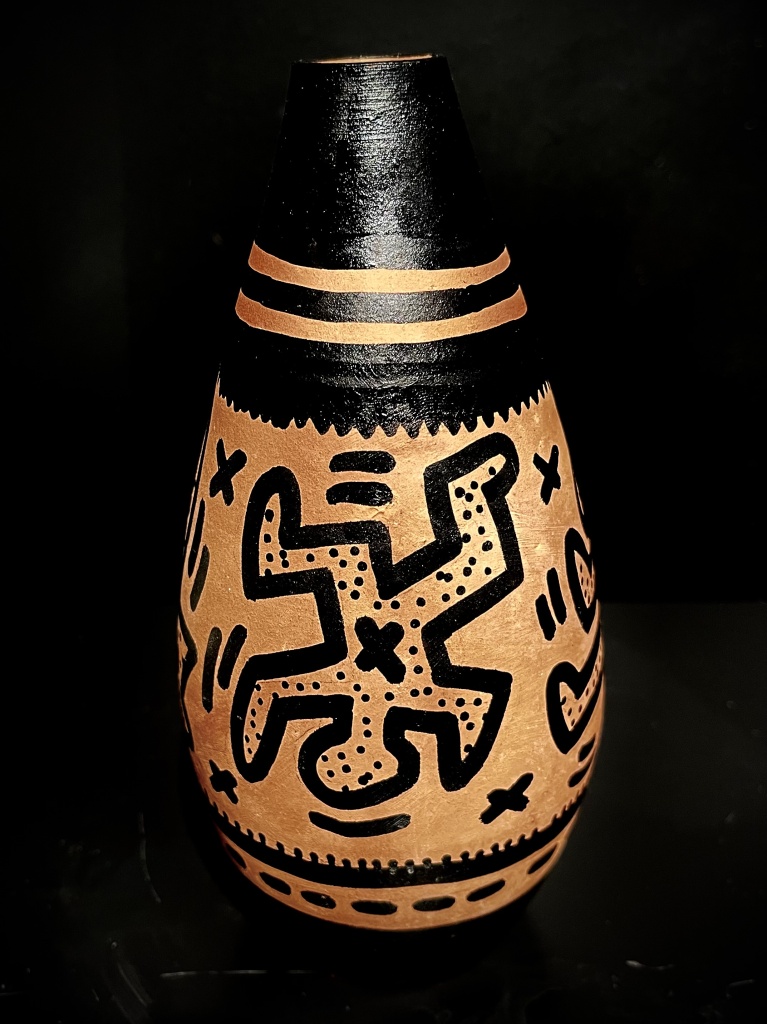
Terracotta Pot
Finally, the terracotta pot titled Figures (1988) demonstrates Haring’s ability to integrate his visual language with historically resonant materials. The contrast between ancient terracotta and contemporary black ink establishes a dialogue between past and present, utility and expression. Moreover, the repetition of animated figures around the vessel creates continuity and rhythmic movement, reinforcing key elements of Haring’s iconography. Signed and dated at the base, the pot functions as a fully realized artwork rather than a decorative adaptation.
Taken together, these three works highlight Haring’s consistent artistic methodology across diverse media. Available through King’s Gallery Jerusalem, these works offer collectors and institutions the rare chance to engage with Keith Haring’s legacy.
Our collection
Kings Gallery is a leading fine art gallery established in Jerusalem in 1995. We strive to collect and sell the highest quality historic and contemporary Israeli and International art. The gallery specializes primarily in artists from the early period of the 1920’s. Besides, Kings Gallery features leading up-and-coming young artists who will definitely be prominent names in the next few years.