
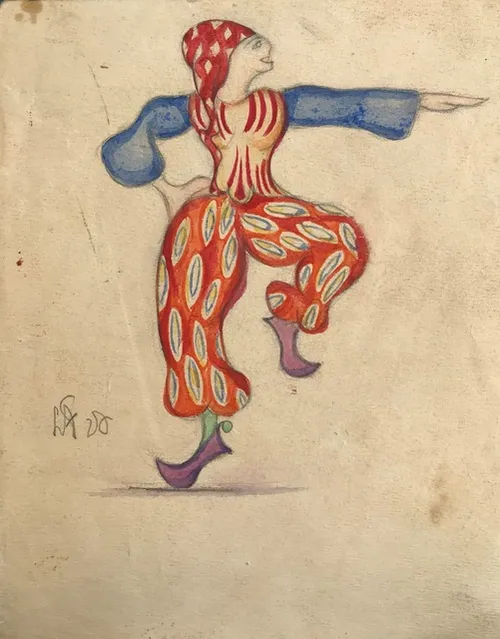
Although Léon Bakst and Sergei Eisenstein belonged to different generations and developed very different careers, both artists explored the relationship between the drawn line, the human body, costume, and theatrical performance.
Two works — Léon Bakst’s Dancer Costume Design, ca. 1910, and Sergei Eisenstein’s Knight, 1921 — reveal this connection particularly clearly. Created just over a decade apart, both drawings capture figures that seem ready to move beyond the paper and enter the space of the stage.
Léon Bakst: Costume in Motion
Léon Bakst revolutionized theatrical design in the early twentieth century. Born in Grodno in 1866 and raised in St. Petersburg, Bakst became closely associated with Sergei Diaghilev and the artistic circle Mir Iskusstva (World of Art). His international reputation grew through his spectacular work for Diaghilev’s Ballets Russes.
Dancer Costume Design, ca. 1910, belongs to this extraordinary period. Executed in watercolor on paper, the work presents a dancer captured in a dynamic pose. Stripes, decorative patterns, pointed shoes, and contrasting areas of color animate the figure.
Bakst designed costumes with movement in mind. Rather than treating clothing as decoration added to the dancer, he used costume to emphasize and extend the movement of the body. Flowing fabrics, rhythmic patterns, and strong silhouettes became part of the choreography.
The drawing already suggests performance. Bakst’s fluid lines give the figure energy, while the position of the body creates the impression of a moment captured in motion. Even without a stage, music, or other performers, the dancer appears theatrical.
Sergei Eisenstein
Sergei Eisenstein approached drawing from a different direction. Today, he remains best known as the groundbreaking filmmaker behind Battleship Potemkin, but drawing, theatre, and visual art played an important role in the development of his artistic thinking.
Rapid strokes give the knight his sense of force and determination. Eisenstein avoids static description. Instead, the lines construct the figure through energy and direction.
Eisenstein created Knight in 1921, using pencil, charcoal, and touches of red. At the time, he worked in theatre and designed costumes and props, including work connected with a production of Macbeth.
This approach reflects one of Eisenstein’s central ideas about drawing: “the line is a trace of movement.” For him, line could communicate more than contour. It could create volume, character, emotion, and action.
Two Artists, Two Visions of Movement
Bakst and Eisenstein used drawing to imagine what a figure could become in performance. Bakst creates movement through color, pattern, costume, and the dancer’s pose. Eisenstein relies on rapid lines, expressive strokes, and the physical force of the knight.
Their approaches differ, but both works challenge the boundary between drawing and theatre.
Dancer Costume Design transforms clothing into choreography. Knight turns the drawn line into action. In both works, the figure refuses to remain still.