
Leon Bakst and the Ballets Russes
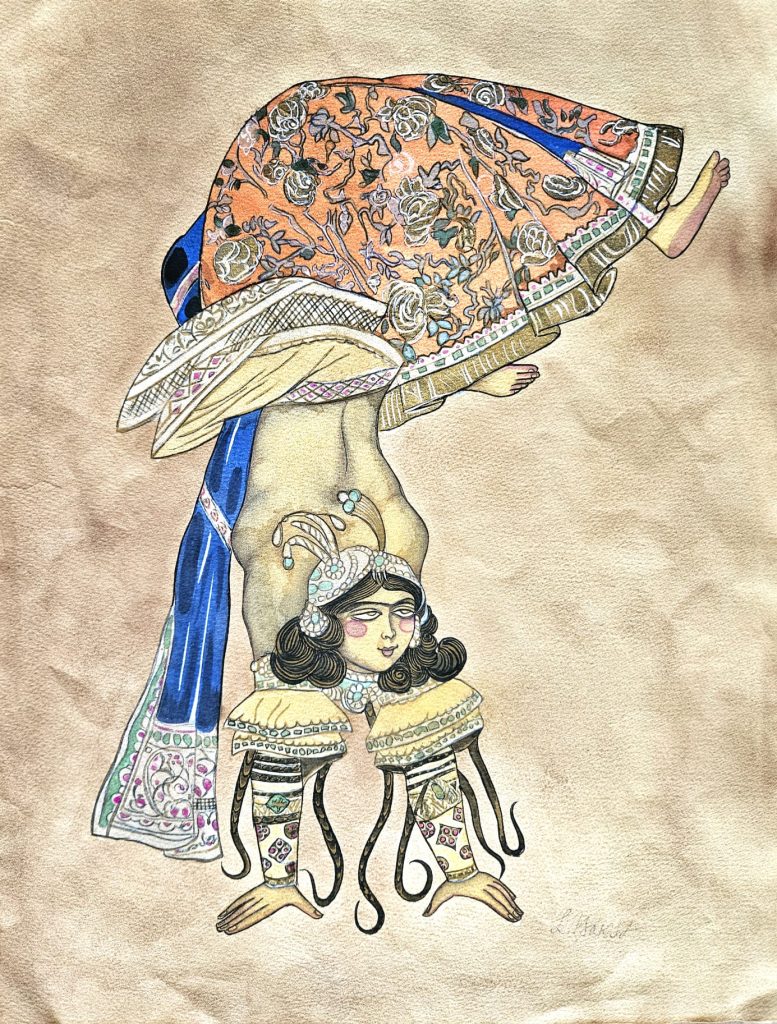
Kings Gallery in Jerusalem proudly presents an extraordinary original work on paper by Leon Bakst, one of the most influential stage and costume designers of the 20th century. Titled Dancer from ‘Le Dieu Bleu’ (1912), this piece measures 43 x 33 cm and captures Bakst’s theatrical design.
Table of Contents
Modern Stage Design
Born Lev Samoilovich Rosenberg in Grodno in 1866, Leon Bakst transformed European visual culture through his revolutionary work for Serge Diaghilev’s Ballets Russes. Bakst studied at the Imperial Academy of Arts in St. Petersburg and co-founded the influential Mir Iskusstva (World of Art) movement.
When Diaghilev launched the Ballets Russes in Paris in 1909, Bakst’s costume and set designs ignited a sensation. His exotic color harmonies, sensuous drapery, and bold integration of Eastern motifs redefined modern aesthetics, directly inspiring fashion, interior design, and visual art across Europe. His iconic designs for ballets like Scheherazade, The Firebird, and Le Dieu Bleu (The Blue God) remain legendary milestones in modern art history.
Le Dieu Bleu
Created for Jean Cocteau and Reynaldo Hahn’s 1912 ballet Le Dieu Bleu with choreography by Michel Fokine, this composition highlights Bakst’s brilliant synthesis of Indian iconography, Southeast Asian dance traditions, and European Art Nouveau.
Set in ancient India before a lotus pool and rock temple, Le Dieu Bleu (1912) tells the story of a Young Girl who disrupts a sacred ceremony to save her beloved from becoming a priest, only for the enraged clergy to condemn her to death alongside subterranean monsters. Just as the beasts emerge, the lotus-born Goddess and the flute-playing Blue God intervene, charming the monsters into the overgrown flora, reuniting the lovers, and ascending to heaven via a golden staircase.
The drawing depicts a female temple dancer executing a dramatic, contorted backbend. Bakst balances the figure directly on her hands, suspending her intricately detailed, floral-embroidered skirt above her arched torso. Rich lapis blue ribbons flow downward, mirroring the curved geometry of her pose, while her elaborate feathered headdress frames a serene face.
Bakst rejects static theatrical portraiture in favor of dynamic energy. His line work retains the fluid elegance of Art Nouveau while introducing the bold, saturated color fields that became his signature. By juxtaposing heavy metallic embroidery with soft skin tones and dramatic inverted perspectives, Bakst transforms the human body into a sculpted decorative object.
When Serge Diaghilev premiered Le Dieu Bleu in Paris in 1912, he placed immense hopes to achieve legendary status. However, contemporary critics responded with mixed enthusiasm, complaining that star dancer Vaslav Nijinsky spent more time posing in stylized, static postures than executing dynamic choreography. Despite these reservations regarding the dance performance itself, Bakst’s artistic contribution saved the production.
Artistically, Le Dieu Bleu continued the Orientalist exoticism Bakst pioneered in Cléopâtre and Schéhérazade. Bakst drew direct architectural inspiration from Louis Delaporte’s 1880 study Voyage au Cambodge, designing massive carved stone faces based on the Bayon Temple of Angkor Thom in Cambodia.
A Rare Opportunity for Connoisseurs
We invite you to visit Kings Gallery in Jerusalem to examine this signed historical treasure in person.
Contact Kings Gallery in Jerusalem today to inquire about purchasing this original for your collection.
Please find other blogs about works by Leon Bakst in our gallery. Kings Gallery is pleased to present an exceptional “Dancer Costume Design, ca. 1910”. (22 x 16 cm. – watercolor on paper).
Another piece has an interesting historical introduction. In 1917, Bakst played a crucial role in introducing Picasso to Olga Khokhlova in Paris, marking a pivotal moment in art history. This meeting marked the beginning of their personal and professional relationship, which would significantly impact Picasso’s work during that time. It is believed that the Sitting Dancer Sketch (Dress design) likely features Olga Khokhlova, the renowned ballerina and Picasso’s wife.
In addition, please take a look at a blog about “La Baie des Anges” by Marc Chagall.