
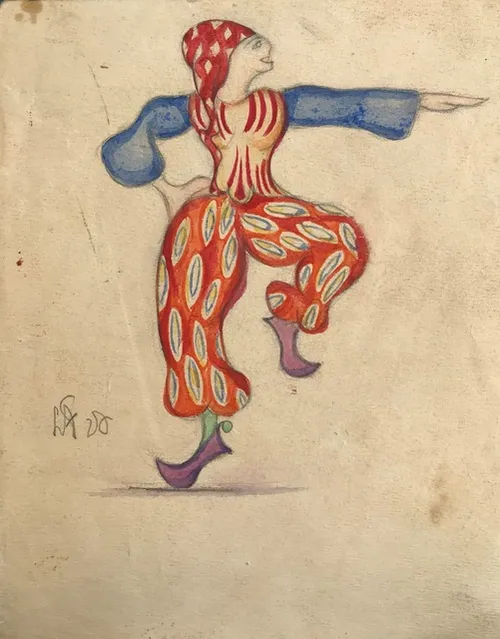
At the turn of the twentieth century, the classical performing arts underwent a radical synthesis that permanently altered the trajectory of modern visual culture. One of the central figures to this aesthetic revolution was Léon Bakst (born Leyb-Kham Rosenberg), a painter, illustrator, and scenographer whose vibrant, exotic designs redefined the relationship between the human body, textile, and stage space.
Kings Gallery is pleased to present an exceptional artifact “Dancer Costume Design, ca. 1910”. (22 x 16 cm. – watercolor on paper)
Biographical Context
Born in Grodno in 1866 into a bourgeois Jewish family, Bakst was raised in St. Petersburg, where he studied at the Imperial Academy of Arts. Disenchanted by the rigid academic realism enforced by the state, he gravitated toward the burgeoning intellectual underground of the city.
In 1898, Bakst co-founded the influential Mir Iskusstva (World of Art) movement alongside Sergei Diaghilev and Alexandre Benois. The movement rejected utilitarian realism in favor of Symbolism, Art Nouveau elegance, and a romanticized reclamation of historical styles. It was during this period that Bakst developed his signature graphic style, characterized by fluid, undulating lines and an extraordinary sensitivity to the narrative potential of color—a style that reached its apotheosis when Diaghilev launched his most ambitious venture in Paris.
The Ballets Russes
The launch of Sergei Diaghilev’s Ballets Russes in 1909 marked an unprecedented milestone in European high culture. Operating under the avant-garde principle of the Gesamtkunstwerk (the Total Artwork) the company unified music, choreography, and visual design into a singular, overwhelming sensory experience.
Prior to Bakst’s involvement, theatrical costuming was largely an afterthought, frequently subordinate to the vanity of the individual performer. Bakst completely overturned this paradigm. For historic productions such as Cléopâtre (1909), Schéhérazade (1910), and The Firebird (1910), he introduced a radical visual vocabulary heavily informed by Orientalism, Greek antiquity, and folklore.
His sets and costumes abandoned pale, pastoral traditions in favor of saturated, clashing jewel tones—emerald greens, deep sapphires, fiery oranges, and intense crimsons. Crucially, Bakst’s designs freed the dancer’s body. By utilizing light, flowing silks and bare limbs adorned with heavy jewelry, his costumes did not merely decorate the dancers; they dictated the kinetic possibilities of the choreography itself, transforming the moving form into a kinetic brushstroke across a living canvas.
Dancer Costume Design, ca. 1910
Executed during the golden age of the Ballets Russes, this watercolor showcases Bakst’s masterly command of rhythmic line and pattern. The figure, captured mid-stride in a highly stylized, expressive pose, is draped in an intricate tunic adorned with vertical stripes and teardrop ocelli.
The color palette is classic Bakst: a bold, contrasting juxtaposition of warm, vibrant vermilion against cool cerulean sleeves, grounded by pointed lavender footwear that evokes the exotic folklore of the East.
The fluid, calligraphic ink lines delineate a sense of rapid, joyous movement, illustrating how Bakst could distill the entire emotional weight of a performance into a single, intimate study on paper.
Acquisition
Dancer Costume Design is currently available for private acquisition. To view the complete digital catalog entry and request a condition report, please contact us.
Kings Gallery is a leading fine art gallery established in Jerusalem in 1995. We strive to collect and sell the highest quality historic and contemporary Israeli and International art. The gallery specializes primarily in artists from the early period of the 1920’s. Besides, Kings Gallery features leading up-and-coming young artists who will definitely be prominent names in the next few years.