
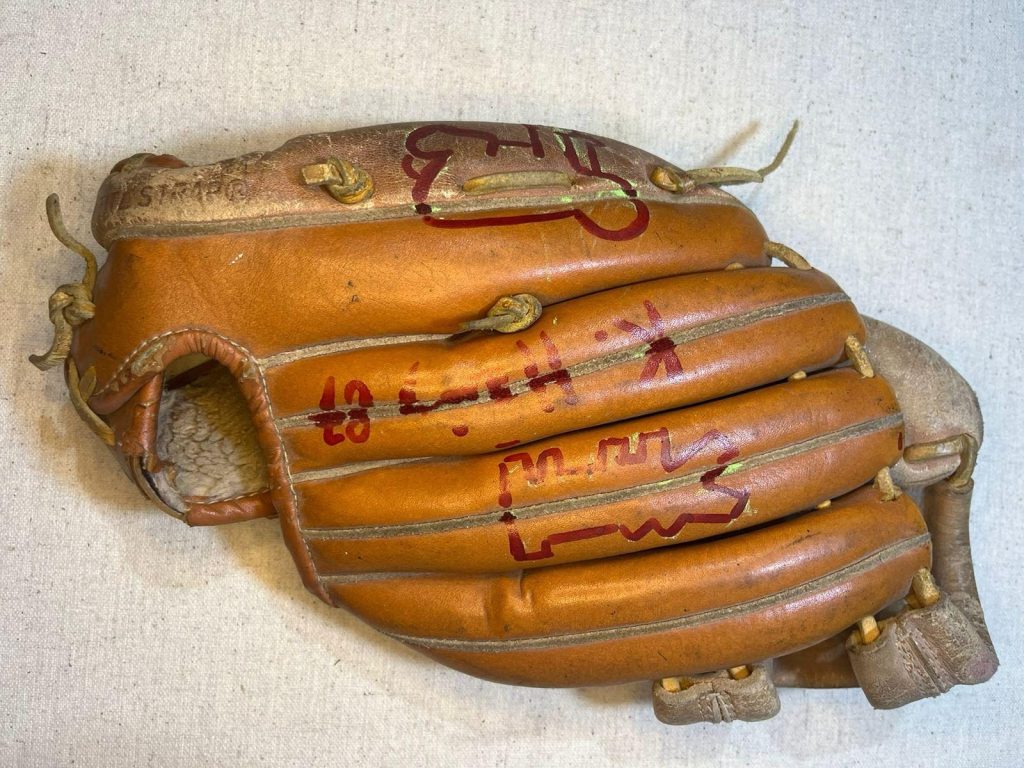
Keith Haring expanded his visual language far beyond conventional drawing surfaces. Walls, subway advertising panels, clothing, vinyl tarpaulins, sculptures, and everyday objects all became supports for his distinctive graphic vocabulary. Baseball Glove, executed in marker on a leather glove measuring 25 × 16 cm, belongs to this broader approach. Instead of separating an image from its support, Haring allows the shape, material, and original function of the object to become part of the work.
Table of Contents
The glove carries several characteristic Haring motifs. Bold red lines create simplified figures and signs across the worn leather surface. Their directness contrasts with the complex construction of the glove, producing a meeting between Haring’s economical drawing style and a functional object already marked by use.
Keith Haring and Drawing on Everyday Objects
Everyday materials played an important role in Keith Haring’s practice. His famous New York subway drawings developed partly because he recognized the unused black advertising panels in subway stations as readily available drawing surfaces. Using white chalk, Haring could work quickly and place his images directly within public circulation. The Keith Haring Foundation identifies this period as fundamental to the development of his recognizable visual vocabulary.
Moreover, Haring never restricted that vocabulary to a single medium. He transferred his lines and symbols across murals, objects, prints, clothing, and sculpture. Changing the support also changed the viewer’s relationship to the image.
Baseball Glove makes this relationship especially clear. The artist does not disguise the object beneath the drawing. Seams, leather strips, laces, openings, and signs of wear remain fully visible. Haring’s marks follow and interrupt this irregular surface, making the existing object part of the composition.
Line, Surface, and Movement
Haring’s line provides the strongest connection between Baseball Glove and his larger body of work. He developed a graphic language based on clear contours, repeated signs, and an economy of means. His figures often communicate movement through pose and surrounding marks rather than anatomical detail.
Here, however, the glove introduces a physical dimension that paper cannot provide. Curved leather surfaces distort the drawn lines, while separate sections divide individual motifs. Viewers cannot take in the entire image from a single flat viewpoint. Instead, the drawing changes as the object turns.
This interaction between line and three-dimensional form distinguishes Baseball Glove from Haring’s works on paper. The glove functions simultaneously as image and object.
The Baseball Glove as an Art Object
The choice of a sports object also introduces associations with the body, physical action, and contact. A glove normally responds directly to the movements of the hand. Haring’s imagery similarly depends on bodies in action: his figures dance, run, crawl, embrace, fight, and interact.
However, the work does not require a single symbolic interpretation. Haring repeatedly used recognizable signs while allowing their meaning to shift according to context. Here, the combination of his graphic figures with a baseball glove creates a direct relationship between drawn movement and an object designed for physical movement.
Furthermore, the aged leather gives the work a material presence very different from the smooth surfaces often associated with prints or drawings. Haring’s marks coexist with scratches, discoloration, stitching, and wear, bringing the history of the object into the visual experience.
Keith Haring’s Visual Language Across Different Media
Baseball Glove demonstrates how easily Keith Haring’s visual language could move between media. His recognizable line remains effective even when it leaves the flat page and encounters an irregular three-dimensional surface.
The work also reflects a larger principle within Haring’s practice: art did not need to remain confined to traditional formats. By drawing directly onto an existing object, he transformed its surface without eliminating its original identity.
For another example of how Haring used a familiar symbol to build meaning through line, repetition, and movement, see our blog about Keith Haring’s Heart. The two works approach his visual language from different directions: Heart concentrates on an iconic motif on paper, while Baseball Glove shows what happens when Haring’s drawing enters the physical world of everyday objects.
Kings Gallery is a leading fine art gallery established in Jerusalem in 1995. We strive to collect and sell the highest quality historic and contemporary Israeli and International art. The gallery specializes in artists from the early period of the 1920’s. In addition, Kings Gallery features leading up-and-coming young artists who will definitely be prominent names in the next few years.