
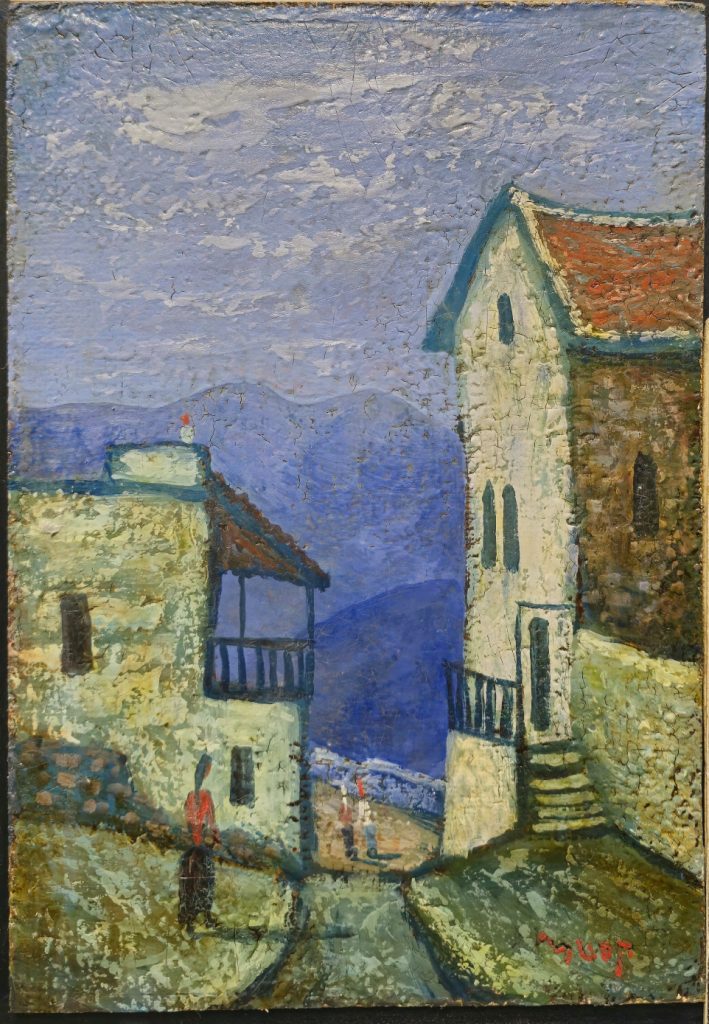
Long before Moshe Castel became famous for monumental works made with basalt, ancient Hebrew forms, and abstract symbols, he painted the streets and stone houses of Jerusalem and Safed. Zfat (Safed), an intimate oil on canvas measuring 38 × 30 cm, belongs to this figurative side of Castel’s art. Rather than presenting the city as a panoramic landscape, Castel brings the viewer directly into one of its narrow streets, surrounded by old stone architecture and the blue mountains of Galilee.
Table of Contents
The painting offers an important perspective on Moshe Castel’s relationship with Safed, a city that became central to both his life and artistic imagination.
Moshe Castel and Safed
Castel’s connection with Safed developed after years of artistic training between Jerusalem and Paris. Born in Jerusalem in 1909, he studied at Bezalel before leaving for Paris in 1927. There, he attended the Académie Julian and the École du Louvre and spent thirteen years absorbing European painting while developing his own approach to color and material. castelmuseum.co.il
After returning to Mandatory Palestine around 1940, Castel settled in Safed. The Moshe Castel Museum specifically connects his attraction to the city with its ancient sacred sites and its history as a center of Jewish mysticism and Kabbalah. castelmuseum.co.il
Therefore, Safed represented much more than a picturesque subject. Its architecture, religious history, mountainous setting, and layers of Jewish memory provided Castel with a visual environment closely connected to themes that would remain important throughout his career.
The Streets of Zefat (Safed)
Architecture dominates the composition. Tall stone buildings rise on both sides of a descending street, creating a narrow opening toward the landscape beyond. Balconies, stairs, tiled roofs, windows, and rough walls establish the physical character of the old city.
Meanwhile, Castel uses the street itself to lead the eye into the painting. The road descends from the foreground toward several small figures and eventually reaches a strip of distant landscape. Instead of creating a grand view of Safed from outside, the artist places the viewer within its built environment.
Color strengthens this effect. Pale stone walls contrast with deep blues and violet tones, while the reddish roof and small touches of red introduce warmth into the cooler palette. The distant mountains almost merge with the sky, making the city appear suspended within its Galilean surroundings.
Texture and the Material Surface
Paint itself plays an important role in Castel’s image of Safed. The walls, road, roofs, and sky possess a visibly worked surface rather than a smooth finish. Thick and irregular passages of paint help suggest the rough texture of stone.
This emphasis on material is particularly interesting in relation to Castel’s later career. During his years in Paris, he became deeply interested in the physical construction of a painting and in the possibilities of layered pigment. The Castel Museum records his belief that the material and the manner in which paint was placed on a surface were fundamental to art. castelmuseum.co.il
Later, that concern with material would become even more radical. After encountering the basalt remains of the ancient synagogue at Korazim in 1948, Castel began incorporating ground basalt into his works and developed the relief-like paintings for which he became internationally known. castelmuseum.co.il
Safed Before Abstraction
Zfat (Safed) reveals an essential stage in Moshe Castel’s artistic development. Here, Jewish history and the landscape of Israel appear not through inscriptions or abstract signs, but through an actual place: stone houses, a descending street, distant mountains, and a handful of human figures.
Yet many concerns of the later Castel are already visible. Architecture becomes history, stone becomes texture, and the physical landscape carries cultural memory. Safed offered Castel a place where these elements could naturally coexist.
For this reason, Zfat (Safed) provides more than a view of one of Israel’s most distinctive historic cities. It offers a glimpse of the figurative foundations from which Castel’s later, increasingly symbolic artistic language would emerge.
Kings Gallery is a leading fine art gallery established in Jerusalem in 1995. We strive to collect and sell the highest quality historic and contemporary Israeli and International art. The gallery specializes in artists from the early period of the 1920’s. In addition, Kings Gallery features leading up-and-coming young artists who will definitely be prominent names in the next few years.