
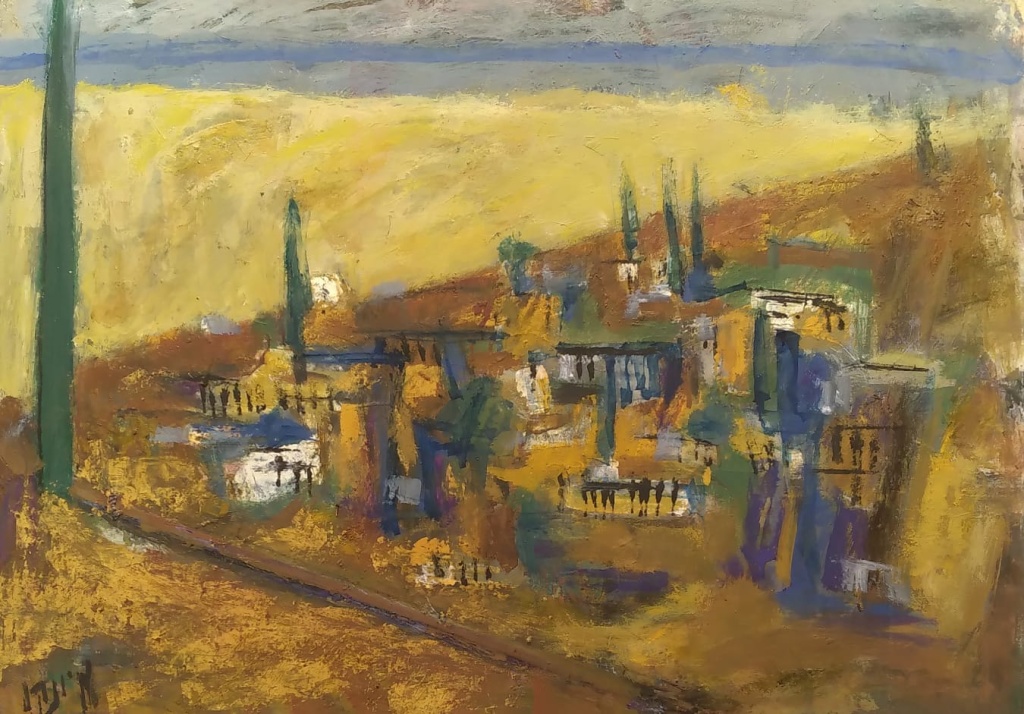
“Village 1948” by Marcel Janco brings together landscape, architecture, and one of the defining dates in the history of modern Israel. Painted in 1951, the work looks back through its title to 1948, the year of the establishment of the State of Israel. Rather than presenting a precise topographical record, Janco constructs the village through blocks of ochre, yellow, blue, green, and brown, transforming buildings and surrounding hills into an expressive composition.
Table of Contents
The painting belongs to a crucial period in Marcel Janco’s Israeli career. By 1951, the Romanian-born artist had already lived in Mandatory Palestine and then Israel for a decade. His artistic background, however, extended back to the European avant-garde and to the beginnings of Dada.
From Dada to Israel
Janco arrived to Eretz Israel in 1941 after an extraordinary European career. Born in Bucharest in 1895, he studied architecture in Zurich and became one of the artists associated with the birth of Dada at the Cabaret Voltaire in 1916. His early work combined experimentation with Expressionism, Cubism, collage, masks, and abstract relief.
After settling in Palestine, however, the landscape and society around him became increasingly important subjects.
Moreover, Janco participated directly in the development of Israeli modernism. In 1948, he became one of the founders of New Horizons (Ofakim Hadashim), the influential artists’ group that encouraged a stronger engagement with international modernist and abstract tendencies in Israeli art.
Village 1948, painted only three years later, stands at this intersection between recognizable landscape and modernist transformation.
The Village as a Modernist Landscape
Color organizes the painting more strongly than precise architectural description. Janco compresses the village into an accumulation of houses, roofs, towers, trees, and vertical accents. Individual structures remain visible, yet their outlines frequently dissolve into neighboring areas of paint.
Meanwhile, the surrounding landscape occupies a major part of the composition. A broad yellow hillside rises behind the settlement, while a narrow band of blue separates earth from sky. The village itself emerges through warmer ochres and browns interrupted by blue, green, white, and violet.
Rather than using conventional perspective to create deep space, Janco builds the landscape through overlapping planes of color. Architecture and nature consequently begin to merge. The village becomes less a collection of individual buildings than a single visual structure embedded within the land.
Why “1948”?
The relationship between the title Village 1948 and the painting’s 1951 date gives the work an important temporal dimension. The title directs attention backward to a specific year, while the painting itself belongs to the first years of the newly established State of Israel.
However, without further documentation, the title should not be treated as evidence that Janco intended the painting as an illustration of a particular historical event. What we can see clearly is his transformation of a village landscape through the vocabulary of modern painting.
That distinction matters especially because Janco’s famous connection with Ein Hod Artists’ Village came slightly later. In 1953, he led a group of artists who established an artists’ community at Ein Hod on the slopes of Mount Carmel. The village developed around studios, workshops, art education, and communal artistic life.
Therefore, Village 1948 predates that project and should not automatically be identified as a view of Ein Hod.
Landscape and the Formation of Israeli Modernism
Village 1948 captures a moment when Marcel Janco was redefining his own artistic language within Israel. European avant-garde experience remained part of his approach, but local architecture, landscape, light, and history provided new subjects.
The painting preserves the recognizable image of a village while breaking that image into color, texture, and shifting planes. In doing so, Janco turns landscape into something more than geographical description.
Ultimately, Village 1948 belongs to the formative years of Israeli art itself: a period when artists such as Janco were negotiating between European modernism and the visual experience of a rapidly changing country.
Kings Gallery is a leading fine art gallery established in Jerusalem in 1995. We strive to collect and sell the highest quality historic and contemporary Israeli and International art. The gallery specializes in artists from the early period of the 1920’s. In addition, Kings Gallery features leading up-and-coming young artists who will definitely be prominent names in the next few years.