
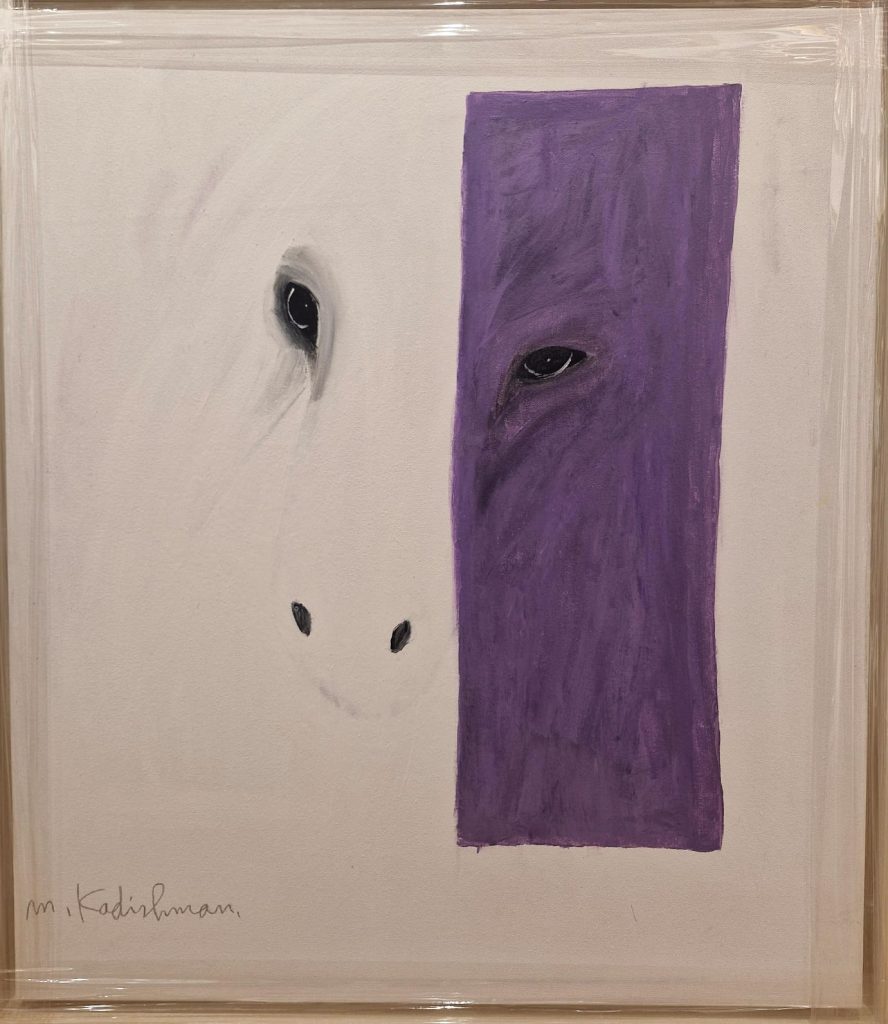
Menashe Kadishman transformed the sheep into one of the most recognizable images in Israeli art. What began with his direct experience as a shepherd eventually developed into a recurring artistic subject that allowed him to explore landscape, identity, sacrifice, memory, and color. In Independence Day (Blue and White) and Purple Eyes, Kadishman reduces the animal to a frontal face and uses large areas of color to change the character of an otherwise closely related image.
Table of Contents
The two paintings demonstrate an important feature of Menashe Kadishman’s sheep paintings: repetition never produces complete uniformity. Similar faces return across his work, yet changes in color, expression, brushwork, and composition give each image a distinct presence.
Menashe Kadishman and the Sheep
Kadishman’s connection with sheep began long before they became a central motif in his paintings. As a young man, he worked as a shepherd on a kibbutz, an experience that later shaped his artistic engagement with animals and the Israeli landscape. The Jewish Museum notes that the sheep developed in his work from a local pastoral image into a broader symbol connected with identity and attachment to the land.
Moreover, sheep entered Kadishman’s international practice dramatically at the 1978 Venice Biennale, where he presented a flock of live sheep whose backs he marked with color. The project connected contemporary art with the traditional practice of marking sheep while turning the moving flock into a constantly changing composition.
Later, the individual sheep’s head became one of Kadishman’s characteristic subjects. The Israel Museum describes the sheep or lamb as the image most closely associated with the artist and emphasizes that Kadishman also connected it with sacrifice and the deaths of young soldiers in Israel’s wars.
Independence Day (Blue and White)
*Blue and white determine the structure of Independence Day (Blue and White).* Kadishman divides the sheep’s face vertically: a saturated blue rectangle covers one side, while white dominates the other. Only the dark eyes interrupt these broad areas of color.
The title immediately introduces an Israeli context. Blue and white correspond to the colors of the Israeli flag, while Independence Day gives the combination a specific national reference. Kadishman had used blue-and-white sheep imagery elsewhere in his work, making this color combination part of his larger exploration of the sheep as an Israeli motif. dangallery.co.il
However, the painting does not function like a conventional patriotic emblem. The animal remains the central subject, and its direct gaze gives the composition an individual presence that complicates the simplicity of the geometric division.
Purple Eyes
Purple Eyes changes the same visual structure through color. Here, a vertical purple field covers part of the sheep’s face. White remains dominant elsewhere, while the eyes and nostrils provide the principal figurative details.
Purple has no explicit national association comparable to the blue and white of Independence Day. Consequently, color works more independently as a formal and expressive element. The contrast between the rectangular field and the organic features of the sheep becomes particularly clear.
Furthermore, the visible brushwork prevents the purple rectangle from becoming a purely geometric shape. Kadishman preserves the physical presence of paint, balancing abstraction against the recognizable animal face.
Color and Repetition in Kadishman’s Sheep Paintings
Together, the two works show how Kadishman could generate variation from a deliberately restricted motif. The frontal sheep, direct gaze, pale ground, and rectangular area of color establish a shared structure. Blue and purple then produce very different visual relationships within it.
This combination of repetition and difference became fundamental to Menashe Kadishman’s art. His sheep could carry personal, local, biblical, and national associations, while remaining individual images rather than illustrations of a single fixed meaning.
Independence Day (Blue and White) and Purple Eyes demonstrate that process particularly clearly. Kadishman keeps the image simple, but allows color to continually redefine how we encounter it.
Kings Gallery is a leading fine art gallery established in Jerusalem in 1995. We strive to collect and sell the highest quality historic and contemporary Israeli and International art. The gallery specializes in artists from the early period of the 1920’s. In addition, Kings Gallery features leading up-and-coming young artists who will definitely be prominent names in the next few years.