
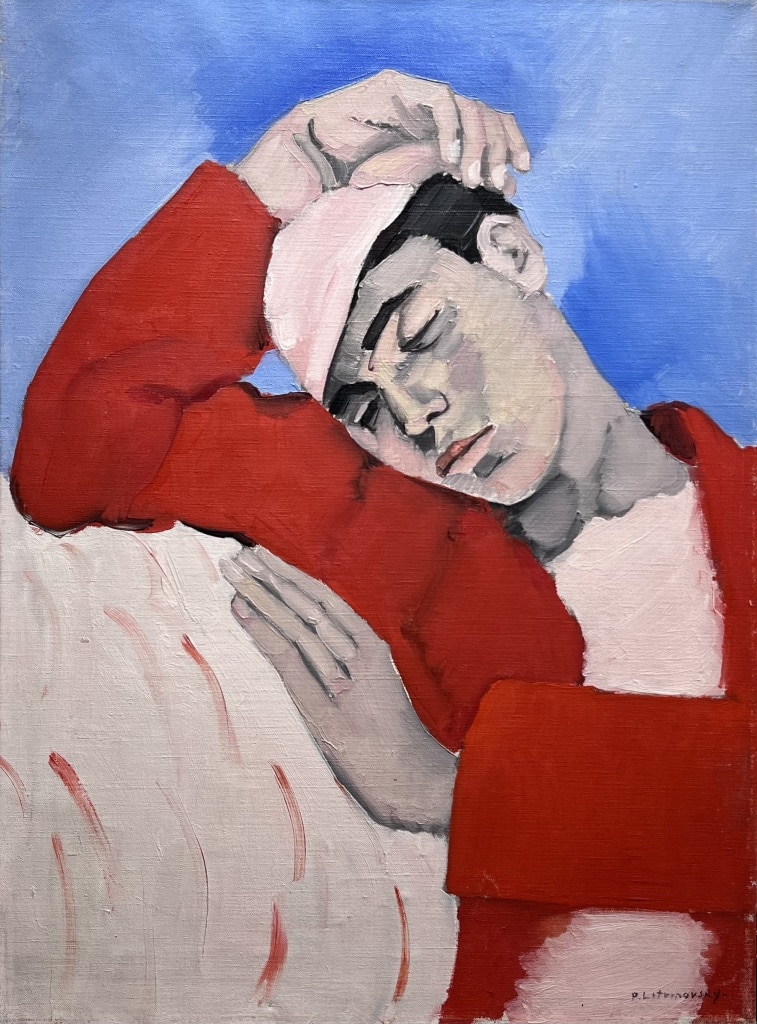
Pinchas Litvinovsky was one of the important figures in the development of modern Israeli art. Known for his expressive figures, distinctive use of color, and changing artistic style, he explored a wide range of subjects throughout his career. His painting “Sleeping Man in Red” offers an intimate example of his approach to the human figure, combining simplified forms with a strong and carefully balanced palette.
Table of Contents
A Study of Rest
In “Sleeping Man in Red,” Litvinovsky depicts a resting figure with closed eyes, leaning against a white pillow. The person’s red clothing immediately attracts attention and establishes the visual structure of the composition. Meanwhile, the deep blue background creates a clear contrast with the warmer tones of the figure.
The artist places particular emphasis on the position of the body. One arm rests above the head, while the other lies across the body. Together, these gestures create a compact composition that focuses the viewer’s attention on the figure rather than its surroundings.
Furthermore, the painting combines recognizable details with simplified shapes. Litvinovsky does not attempt to reproduce every anatomical feature realistically. Instead, he uses broad areas of color, strong outlines, and visible brushstrokes to define the face, hands, and clothing.
Pinchas Litvinovsky: From Ukraine to Israeli Modernism
Pinchas Litvinovsky (1894–1985) was born into a religious Jewish family in Ukraine. At the age of eighteen, he began studying at the Odessa Art School, where he encountered Boris Schatz, founder of the Bezalel School of Arts and Crafts in Jerusalem.
Litvinovsky subsequently joined Bezalel, but in 1912 he left the institution together with Reuven Rubin because of disagreements about artistic principles and teaching methods. He continued his studies in Russia at the Imperial Academy of Arts in Saint Petersburg. Finally, in 1919, he emigrated to Palestine with his wife.
Throughout his career, Litvinovsky experimented with different artistic approaches. Russian Constructivism influenced his early work, while his 1929 trip to Paris introduced him to new artistic ideas, including the work of Georges Rouault.
By the late 1930s, he had developed a more colorful visual language, characterized by expressive figures, strong contrasts, and increasingly abstract backgrounds. These elements became particularly important in his paintings of the 1940s and 1950s.
In 1980, Litvinovsky received the Israel Prize for his contribution to Israeli art.
Color and Artistic Technique
“Sleeping Man in Red” demonstrates Litvinovsky’s interest in the relationship between color and form. The strong red clothing provides the central visual accent, while the blue background gives the composition depth and clarity.
Additionally, the artist uses broad, confident brushstrokes to construct the figure. Subtle variations in grey, beige, and white define the face and hands, while darker tones emphasize the hair and facial features.
Rather than relying on intricate details, Litvinovsky builds the image through the interaction of color fields and simplified shapes. As a result, the painting retains a sense of immediacy while demonstrating a considered approach to composition.
Pinchas Litvinovsky at Kings Gallery
Kings Gallery presents works by Pinchas Litvinovsky alongside paintings by other significant Israeli and international artists. His artistic development, from early modernist experiments to expressive figurative compositions, offers an important perspective on the history of Israeli art.
“Sleeping Man in Red,” an oil painting on canvas dated 2025, is part of the gallery’s collection history.
Our Gallery
In addition, our collection brings together established masters and contemporary artists, offering collectors and art enthusiasts the opportunity to explore different artistic traditions and approaches.