
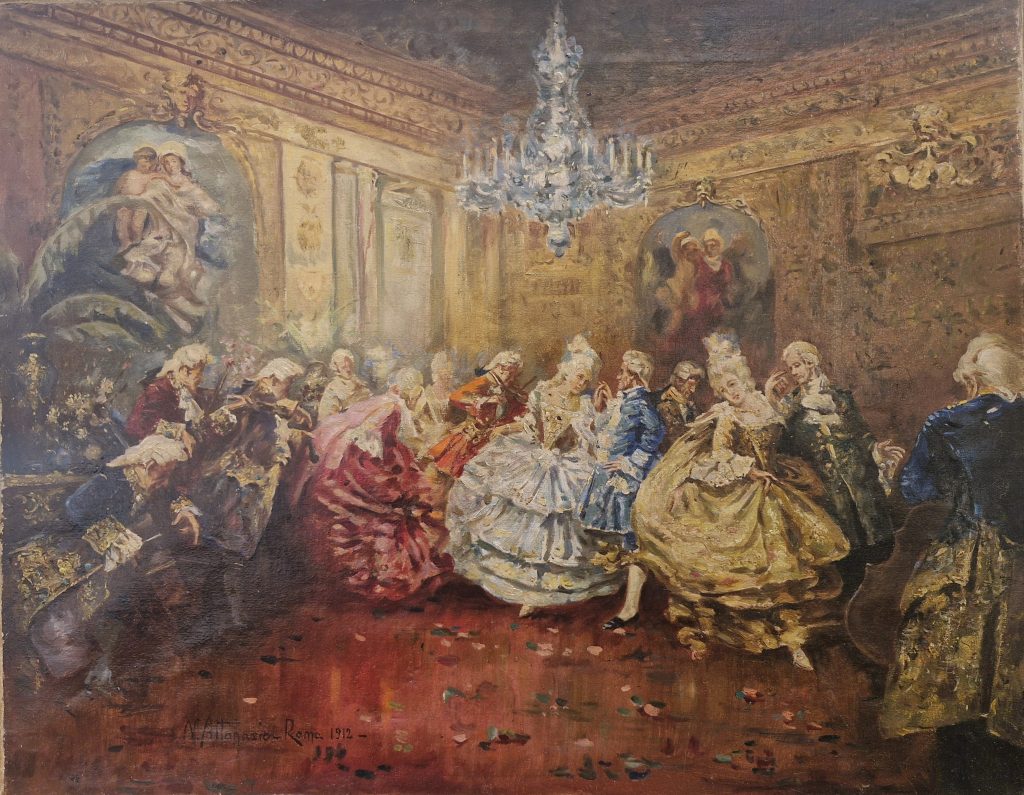
Natale Attanasio’s Roma, 1912 brings together historical costume, a richly decorated interior, and a large group of figures engaged in conversation and social interaction. Painted in Rome in 1912, the work belongs to the final phase of Attanasio’s career, when he produced a number of compositions centered on Baroque-style interiors and costumed gatherings.
Table of Contents
Natale Attanasio: From Catania to Rome
Natale Attanasio (1845–1923) built his career around figurative painting. Born in Catania, Sicily, he studied at the Institute of Fine Arts in Naples and regularly attended the studio of Domenico Morelli, whose approach strongly influenced his artistic development. Attanasio exhibited historical paintings, works concerned with contemporary social subjects, and portraits.
In 1882, Attanasio moved his studio to Rome, where he remained professionally active for much of the rest of his life. His practice extended beyond easel painting: he completed decorative projects in Sicily and Rome, including work for the Teatro Massimo Bellini in Catania and the reading room of the Italian Senate.
Moreover, Attanasio maintained a strong interest in narrative throughout his career. His paintings often depend on relationships between figures, gestures, facial expressions, and carefully constructed settings.
A Baroque World Painted in 1912
Historical costume immediately defines the visual character of Roma, 1912. Women in full dresses occupy the central area, while men in darker clothing appear throughout the gathering. Powdered wigs, elaborate fabrics, and formal clothing establish a deliberate distance from the everyday appearance of early twentieth-century Rome.
The subject also corresponds with other documented works from Attanasio’s late career. Another painting signed “N. Attanasio 1912” has been catalogued as Festa barocca a tema and described as a Baroque-themed costume gathering. The close date and related subject provide useful context for understanding Attanasio’s interest in historical costume during this period, although they do not establish a specific event or identity for the figures in Roma.
Color, Costume, and Composition
Color organizes the crowded interior. Pink, pale blue, cream, yellow, and white dresses form a sequence of lighter areas across the composition. Meanwhile, darker garments create contrast and help separate individual groups within the gathering.
Gesture creates a second visual structure. Figures turn toward one another, form small conversational groups, and look in different directions. Attanasio avoids placing all attention on one protagonist. Instead, the viewer’s eye moves across several simultaneous interactions.
In addition, the architectural setting contributes to the composition. The chandelier establishes a strong central vertical axis, while paintings and decorative wall elements frame the gathering. Attanasio consequently integrates figures, costume, and interior decoration rather than treating the room as a neutral background.
Roma, 1912 and Attanasio’s Late Career
By 1912, Natale Attanasio had worked in Rome for approximately thirty years. His earlier career included historical subjects, socially engaged paintings, portraits, and major decorative commissions. (Istituto Matteucci).
Roma, 1912 shows another aspect of that broad practice. Here, Attanasio concentrates on historical costume, social interaction, and the visual complexity of an ornate interior. Rather than constructing the composition around a dramatic event, he distributes attention among many figures and details.
Ultimately, Roma, 1912 demonstrates Attanasio’s ability to organize a complex figurative scene through color, gesture, costume, and space. The painting also documents his continued engagement with historical and genre subjects during the final decade of his career. It is a depiction of epoque.
Kings Gallery is a leading fine art gallery established in Jerusalem in 1995. We strive to collect and sell the highest quality historic and contemporary Israeli and International art. The gallery specializes in artists from the early period of the 1920’s. In addition, Kings Gallery features leading up-and-coming young artists who will definitely be prominent names in the next few years.