
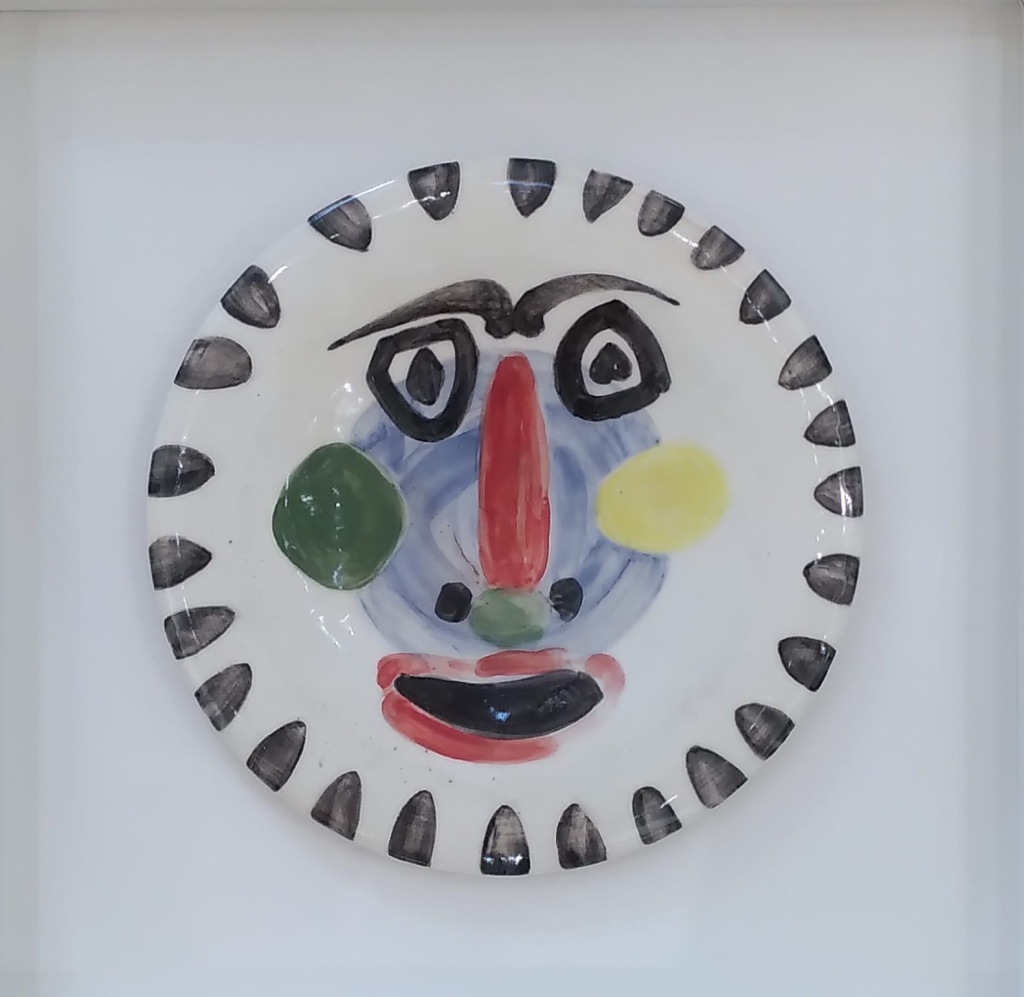
Pablo Picasso created Plate Visage (Face Plate) as part of his celebrated ceramic series produced at the Madoura pottery workshop in Vallauris, France. Measuring 25 cm in diameter and executed in earthenware with colored engobes and glaze, the piece exemplifies Picasso’s joyful experimentation with everyday objects during the 1960s.
Table of Contents
Pablo Picasso and the Ceramic Revolution
By the late 1940s, Picasso had already revolutionized painting, sculpture, and printmaking. In 1946, he discovered the Madoura workshop in Vallauris and began an intensive collaboration that lasted until the early 1970s. During this period, he produced nearly 4,000 ceramic works, including plates, vases, pitchers, and sculptural forms. These pieces allowed him to explore form, color, and texture with the spontaneity of a child while maintaining the sophistication of a master.
The Visage series, particularly the numbered plates from 1963, represents one of the most playful and accessible expressions of Picasso’s genius. He treated each plate like a canvas, drawing whimsical, stylized faces that blend humor, primitivism, and modernist abstraction.
Artistic Analysis of “Visage”
This particular plate features a bold, expressive face rendered with Picasso’s signature line and vibrant color. Thick black arched eyebrows, asymmetrical eyes, a prominent vertical green nose, rounded pink cheeks, and a wide, curved black smile create an immediate, almost cartoon-like presence.
Wavy blue forms frame the face, while radiating gray strokes at the bottom suggest a beard or decorative border, adding rhythm and movement.
The combination of bold black outlines with soft blue, green, and pink engobes on white earthenware produces a fresh, lively effect. The partially glazed surface enhances the tactile quality and depth.
Picasso’s approach here reflects his lifelong fascination with primitive art, Iberian sculpture, and African masks.
Significance
The 1963 Visage plates belong to a limited edition series’s N.202. This is a plate number 151 out of 500, as we see on the reverse side. Marked on the reverse with “Edition Picasso” and “Madoura,” these ceramics bridge fine art and functional objects. They remain highly sought after by collectors because they capture Picasso’s inventive spirit at an accessible scale compared to his major paintings.
Today, such plates are prized not only for their artistic value but also as tangible links to Picasso’s creative process in the south of France. They embody his famous quote: “It took me four years to paint like Raphael, but a lifetime to paint like a child”.
The plate’s bold design makes a striking statement on a wall, in a vitrine, or as part of a table setting.
Furthermore, Picasso ceramics have shown strong market performance, offering an entry point into his oeuvre for both new and seasoned collectors.
The work merges high art with the ancient Mediterranean ceramic tradition, reflecting Picasso’s deep connection to the South of France.
Our Gallery
This Plate Visage is currently available at Kings Gallery in Jerusalem.
Kings Gallery is a leading fine art gallery established in Jerusalem in 1995. We strive to collect and sell the highest quality historic and contemporary Israeli and International art. The gallery specializes primarily in artists from the early period of the 1920’s. Besides, Kings Gallery features leading up-and-coming young artists who will definitely be prominent names in the next few years.