
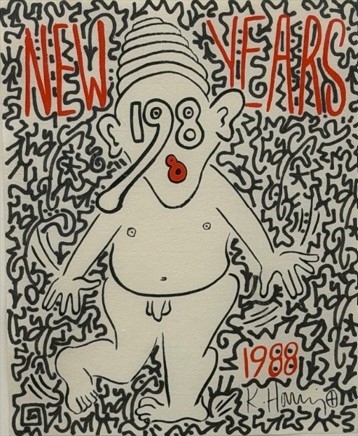
Keith Haring transformed the visual language of New York street culture into one of the most recognizable artistic styles of the 1980s. His bold outlines, animated figures, and playful symbols brought together graffiti, popular imagery, and contemporary art. Created in 1988, New Year 1988 reflects this distinctive approach while also highlighting an important collaboration with fellow artist and graffiti writer LA II (Angel Ortiz).
Table of Contents
The work combines Haring’s characteristic imagery with dense black-ink graffiti elements. This dialogue between two different visual languages gives the composition its particular rhythm and energy.
Keith Haring and the New York Street Art Scene
Born in Pennsylvania in 1958, Keith Haring moved to New York in 1978 to study at the School of Visual Arts. There, he became immersed in the city’s downtown art scene, where graffiti, music, dance, and experimental visual culture increasingly influenced his work.
Haring first gained widespread attention through his chalk drawings on unused advertising panels in the New York subway. His simple, continuous lines and instantly recognizable figures allowed him to communicate through images that were accessible beyond the traditional gallery environment.
Moreover, Haring developed a visual vocabulary of recurring symbols, including radiant babies, dancing figures, barking dogs, and energetic human forms. These motifs became central to his paintings, prints, murals, and public projects.
The Collaboration with LA II
An important dimension of New Year 1988 is its connection to Angel Ortiz, known as LA II or LA2.The two artists met in New York around 1980, when Haring noticed Ortiz’s distinctive graffiti lettering on the Lower East Side.
Their collaboration brought together two contrasting approaches to drawing. Haring developed fluid outlines and simplified figures, while LA II introduced dense, interlocking tags and calligraphic marks. Rather than competing, these visual languages complemented one another.
In this work, the black-ink graffiti fills and activates the spaces around Haring’s imagery. The result reflects the collaborative spirit of New York’s downtown art scene, where artistic boundaries between street culture and gallery practice were increasingly fluid.
New Year 1988: A Visual Celebration
The title places the composition within the context of the New Year, while the year 1988 becomes part of the visual imagery itself. Haring combines his characteristic playful figure with graphic lettering and energetic marks, creating a composition that feels both spontaneous and carefully structured.
The relationship between image and text is particularly important. Graffiti is not simply an addition to the composition; it becomes an integral part of its visual organization. Lines, symbols, and lettering interact across the surface, creating movement and visual density.
Furthermore, the work reflects Haring’s interest in making art that communicates directly. Its accessible imagery and lively graphic language connect with the festive associations of the New Year without relying on a conventional holiday illustration.
Keith Haring and the Art of Collaboration
New Year 1988 demonstrates how Haring’s artistic language developed through exchange with other creators and the visual culture surrounding him. His partnership with LA II is an important part of this history, showing how graffiti lettering and contemporary figurative art could combine within a single composition.
Ultimately, the work offers more than a celebration of a particular year. It captures the energy of 1980s New York and the creative dialogue between two artists whose distinct styles helped shape a memorable chapter in contemporary street art.
This unique work, executed in 1988, is made with markers and ink on paper and measures 50 × 43 × 3.5 cm including the frame.
Kings Gallery is a leading fine art gallery established in Jerusalem in 1995. We strive to collect and sell the highest quality historic and contemporary Israeli and International art. The gallery specializes in artists from the early period of the 1920’s. In addition, Kings Gallery features leading up-and-coming young artists who will definitely be prominent names in the next few years.