
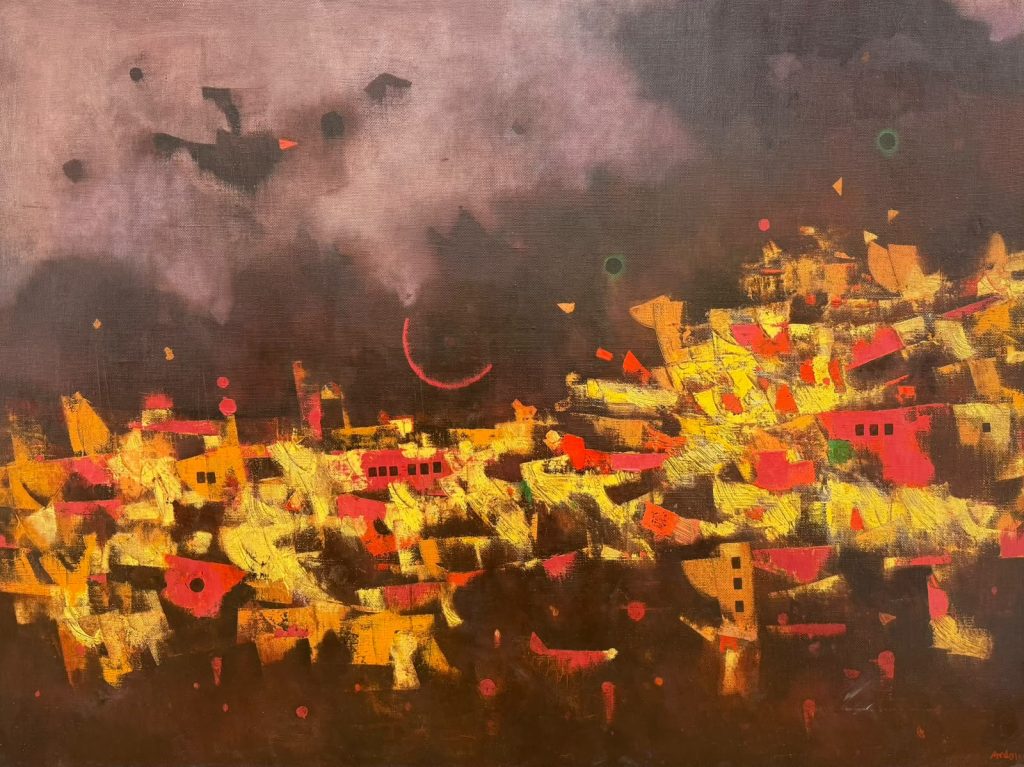
Mordecai Ardon was one of the most influential figures in Israeli modern art. Recognized for his expressive use of colour, distinctive compositions, and combination of European modernism with classical painting techniques, he developed a visual language that became highly individual. His painting “Mount Carmel,” dated 1980, offers an excellent example of his mature artistic style, transforming an Israeli landscape into a composition of colour, texture, and geometric forms.
Table of Contents
Mount Carmel: Landscape and Abstraction
In “Mount Carmel,” Ardon moves beyond a conventional representation of the landscape. Instead of depicting mountains, trees, and buildings in a strictly realistic manner, he arranges the scene through layers of abstract and architectural shapes.
The lower part of the composition features a dense arrangement of yellow, orange, and red forms. These shapes suggest buildings and structures gathered across the landscape, while their simplified outlines create a rhythm of vertical and horizontal elements. Above them, a large dark area dominates the upper half of the canvas, introducing a strong contrast with the bright colors below. It reminds a water reflection of the city.
Small geometric details, including circles, triangles, and irregular shapes, appear throughout the composition. Consequently, the landscape becomes both recognizable and abstract, allowing the viewer to experience the subject through Ardon’s distinctive visual language.
Mordecai Ardon and His Artistic Background
Mordecai Ardon (1896–1992) was born in Poland and studied at the Bauhaus in Germany between 1921 and 1925. There, he encountered influential artists and teachers, including Paul Klee, Wassily Kandinsky, Lyonel Feininger, and Johannes Itten.
These encounters had a lasting impact on his artistic development. In addition, Ardon studied the techniques of the Old Masters under Max Doerner at the Munich Academy in 1926. He combined these classical methods with the experimental approaches of modern European art, developing a distinctive style that brought together abstraction, expressionism, and rich painterly surfaces.
In 1933, Ardon immigrated to Palestine and settled in Jerusalem. The landscape of his new home became an important source of inspiration. As the Israel Museum has noted, his artistic interest developed from early depictions of Jerusalem and its hills toward increasingly abstract explorations of colour, texture, and the natural world.
Colour, Texture, and Composition
One of the most striking features of “Mount Carmel” is its use of contrasting colours. The warm yellows, oranges, and reds create a luminous central landscape, while the dark brown and purple tones above establish depth and visual weight.
Furthermore, Ardon combines different types of brushwork and surface textures. Some areas appear dense and layered, while others contain more delicate marks and small geometric accents. This variation gives the composition movement and complexity.
Rather than relying on conventional perspective, Ardon organizes the painting through the relationship between colour, shape, and spatial layers. As a result, the landscape becomes an independent artistic construction rather than simply a view of a particular location.
Ardon’s Mature Artistic Style
By 1980, Ardon had developed a highly recognizable approach to painting. His work increasingly moved away from direct representation and toward abstract compositions, in which landscape, memory, and visual structure came together.
Nevertheless, his paintings retained a connection to the physical world. In “Mount Carmel,” the recognizable suggestion of buildings and landscape remains present, even as the artist simplifies and transforms these elements.
This balance between representation and abstraction is characteristic of Ardon’s mature work and demonstrates his contribution to the development of modern Israeli painting.
Discover Mordecai Ardon at Kings Gallery
Mordecai Ardon occupies an important place in the history of Israeli art. His combination of European modernist influences, classical painting techniques, and personal interpretations of the Israeli landscape continues to make his work relevant to collectors and art enthusiasts.
For further information about this artwork, please contact Kings Gallery.
Our Gallery
Kings Gallery is a leading fine art gallery established in Jerusalem in 1995. We specialize in historic and contemporary Israeli and international art, with particular attention to artists who shaped the development of modern art during the twentieth century.
In addition, our collection brings together established artists and emerging talents, offering collectors the opportunity to discover works from different artistic periods and traditions.