
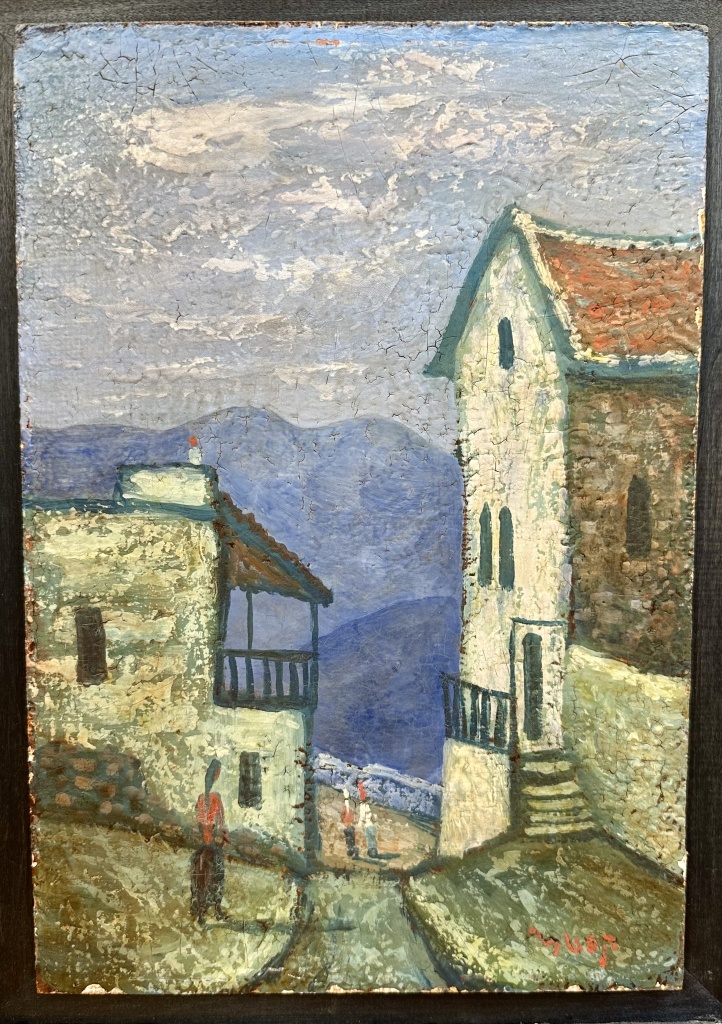
As the month of Elul progresses, the ancient city of Safed feels especially resonant. Traditionally a time of reflection, spiritual preparation, and return. In Moshe Castel’s paintings of Safed unfolds across rooftops, mountains, old stone walls, and the extraordinary landscape of the Galilee.
Table of Contents
Among Castel’s works devoted to the city, “Safed”, painted in the 1940s in oil on wood, offers a particularly beautiful example. Rather than presenting Safed simply as a picturesque landscape, Castel transforms the view of the city into an image suspended between the physical and the spiritual.
Moshe Castel
Moshe Castel (1909–1991) was one of the major figures of twentieth-century Israeli art. Born in Jerusalem into a Sephardic family whose roots went back to the Jews expelled from Castile in 1492, Castel grew up surrounded by Jewish religious and artistic traditions. His father, Rabbi Yehuda Castel, was a Torah scholar and scribe who also created decorative textiles for synagogues and was deeply involved with Hebrew language and liturgical poetry.
Castel entered the Bezalel School of Arts and Crafts as a young teenager and, in 1927, left Jerusalem for Paris. There he studied at the Académie Julian and the École du Louvre and spent more than a decade immersed in European painting. He exhibited in Paris and studied the techniques of the Old Masters, particularly their handling of paint, surface, and layers. (castelmuseum.co.il)
Yet after years in Paris, Castel returned to the Land of Israel and settled in Safed in 1939. The decision would become crucial to his artistic development. Safed’s ancient religious sites, its association with the great Kabbalists, its stone architecture, and its dramatic mountain landscape connected the modern painter with a much older Jewish visual and spiritual world. Castel later became one of the important figures associated with the city’s Artists’ Quarter. (castelmuseum.co.il)
The City as the Subject
In “Safed,” the city itself becomes the protagonist. Castel looks across a landscape composed of architecture, figures, mountains, and sky. The old buildings seem to emerge organically from the Galilean terrain rather than stand apart from it. Soft purples and blues extend into the distant mountains, while the textured surfaces of the foreground evoke the weathered stone for which Safed is known. (Kings Gallery)
This is important because Castel was deeply sensitive to the relationship between place and material. He once recalled being born facing “the rocks and the splendid vistas of the cities of Judea,” landscapes that remained with him throughout his career. In the Safed cityscape, architecture and landscape similarly seem inseparable: houses become almost geological forms, while the mountains acquire the stillness and permanence of architecture.
Small human figures appear in the foreground. Their presence gives scale to the city, but they do not dominate it. Instead, they seem absorbed into a place much older than themselves. They might be inhabitants, visitors, or pilgrims; Castel leaves their identities open. What matters is their relationship to the city surrounding them. Castel paints an experience of the city.
Between Paris and the Galilee
The work also belongs to a fascinating transitional period in Castel’s career. His Paris years had given him direct contact with modern European art, while his return to the Land of Israel brought him increasingly toward local materials, Jewish history, Hebrew script, and ancient visual traditions. The Safed paintings occupy an important position between these worlds.
In this work, Castel still paints with oil and employs a recognizably European pictorial language of landscape, atmosphere, and depth. Yet the subject is unmistakably local. The muted colors, dense surfaces, and almost timeless quality of the city begin to anticipate the artist’s later search for an artistic language rooted in the physical and historical landscape of Israel.
By 1948, Castel would become one of the founders of New Horizons (Ofakim Hadashim), one of the most significant groups in the development of Israeli modernism. Around the same period, he became fascinated by the ancient basalt stones of the synagogue at Korazim. In the following decades, basalt, Hebrew letters, biblical references, and archaic-looking signs would become central elements of his distinctive artistic language. (castelmuseum.co.il)
Seen from this perspective, the earlier view of Safed becomes particularly compelling. The ancient city is already providing Castel with what would preoccupy him throughout his mature career: stone, history, Jewish memory, and the transformation of the past into modern art.
From the City to the Home: “Candle Light in Safed”
Castel’s connection to Safed was not limited to panoramic views.
In “Candle Light in Safed,” the perspective changes dramatically. Instead of looking across the city and toward the Galilean mountains, we enter an intimate domestic space. A female silhouette appears beneath an archway, accompanied by challot and the warm glow of Shabbat candles. (Kings Gallery)
The two paintings can therefore be seen almost as complementary visions of Safed – outward and inward.
In one, spirituality is embedded in mountains, stones, architecture, and the historical character of the city. In the other, it is concentrated in candlelight, ritual, and domestic life. Together they suggest why Safed became such an important subject for Castel: for him, the sacred character of the city was present both in its monumental landscape and in the quiet rhythms of everyday Jewish life.
Safed in the Month of Elul
This dialogue between outer landscape and inner reflection feels especially appropriate during Elul.
Elul precedes Rosh Hashanah and Yom Kippur and is traditionally associated with introspection, repentance, and preparation for the approaching High Holidays. Safed has its own powerful connection to these ideas. As one of Judaism’s historic centers of Kabbalah, the city has long been associated with prayer, contemplation, and the search for spiritual meaning.
Castel’s “Safed” does not illustrate Elul literally. There is no explicit representation of the month or its rituals. Yet its mood feels remarkably suited to this moment.
At the beginning of Elul, Castel’s Safed can therefore be viewed not only as a beautiful representation of one of Israel’s most remarkable cities, but also as an invitation: to look more slowly, to remember, and to turn our attention from the visible landscape toward what lies beyond it.
The signed “Safed” by Moshe Castel, an early oil on wood from the 1940s, is currently presented by King’s Gallery in Jerusalem. (Kings Gallery)