
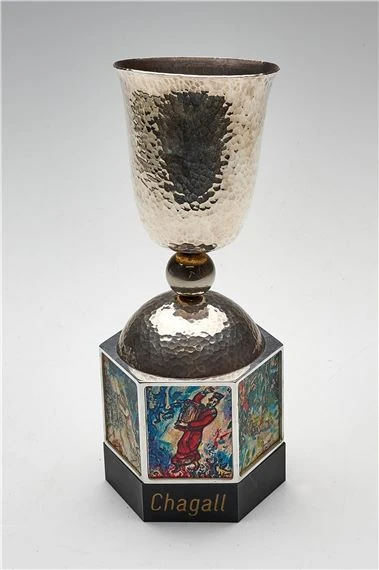
Discover the Marc Chagall Kiddush Cup (1994), an exceptional silver ceremonial object combining the artistic vision of one of the twentieth century’s most celebrated artists with the rich traditions of Jewish ritual. Featuring colorful serigraphs inspired by Chagall’s monumental Exodus from Egypt tapestry, this distinctive Kiddush cup brings together fine craftsmanship, Jewish heritage, and modern art. Presented by Kings Gallery Jerusalem.
Table of Contents
The Marc Chagall Kiddush Cup is a remarkable example of the meeting between fine art and Jewish ceremonial tradition. Created in 1994, this elegant silver goblet transforms a traditional ritual object into an artistic composition inspired by one of Chagall’s important works.
The cup is crafted from solid .975 silver and measures 21.5 cm in height and 10 cm in width. Its hammered silver surface gives the goblet a distinctive texture, while its rounded stem and sculptural proportions create a harmonious overall appearance.
The most striking feature is its hexagonal base, which incorporates six different colorful serigraphs. Each face displays a detail reproduced from Marc Chagall’s celebrated tapestry The Exodus from Egypt, presented by the artist as a gift to the Knesset, the Parliament of Israel.
The reproductions feature a rich palette of 17 colors and are printed on high-quality 270-gram art paper. They were produced by master graveur Yitzhak Schwartz of the Israel Museum in Jerusalem.
The artist’s name, Chagall, is prominently engraved on three alternating faces of the hexagonal base, making the attribution visible from different viewing angles.
Marc Chagall: A Master of Jewish Modern Art
Marc Chagall (1887–1985) was one of the most influential artists of the twentieth century. Born in Vitebsk, in the Russian Empire, he developed a distinctive artistic language that combined modernist experimentation with personal memories, Jewish traditions, and symbolic imagery.
Throughout his career, Chagall explored themes of spirituality, identity, love, memory, and cultural heritage. His paintings are recognizable for their expressive colors, dreamlike compositions, and recurring references to Jewish life and biblical narratives.
Although associated with several major modernist movements, including Cubism and Expressionism, Chagall maintained an individual artistic vision that resisted strict classification.
Jewish culture remained a central source of inspiration throughout his career. Biblical stories, traditional ceremonies, religious symbols, and memories of his childhood frequently appeared in his paintings, prints, stained-glass windows, and monumental projects.
His engagement with Jewish heritage extended beyond painting. Chagall also created important works for public and religious spaces, including the stained-glass windows of the Hadassah Medical Center in Jerusalem and the monumental decorations for the Knesset.
The Exodus from Egypt: A Biblical Theme in Chagall’s Art
The colorful images decorating the Kiddush cup are inspired by Chagall’s tapestry The Exodus from Egypt, a work closely connected to Jewish history and collective memory.
The Exodus narrative, describing the liberation of the Israelites from slavery in Egypt, occupies a central place in Jewish religious and cultural tradition. It is commemorated annually during Passover and has inspired generations of artists.
Chagall approached biblical subjects through his characteristic visual language, combining recognizable figures and symbols with expressive colors and imaginative compositions.
By incorporating reproductions from the Exodus tapestry into the design of the Kiddush cup, the artist’s imagery becomes part of an object associated with another important Jewish ritual.
A Silver Kiddush Cup
The Kiddush cup holds a special place in Jewish tradition. Used to recite the blessing over wine, it is an essential ceremonial object for Shabbat and Jewish holidays.
The Marc Chagall Kiddush Cup offers a distinctive modern interpretation. Its silver goblet preserves the familiar form of a ceremonial vessel, while the hexagonal base introduces a contemporary artistic element through Chagall’s colorful imagery.
The combination of hammered silver, geometric construction, and reproduced artwork creates an unusual dialogue between craftsmanship and fine art.
Rather than separating art from everyday ritual, this work brings the two together, allowing an important artistic vision to become part of Jewish ceremonial life.
Discover Marc Chagall at Kings Gallery Jerusalem
At Kings Gallery, we are dedicated to presenting exceptional works of Israeli and international art, connecting collectors with artists whose creations have shaped modern art and cultural history.
Established in Jerusalem in 1995, Kings Gallery has spent three decades building relationships with artists, estates, and collectors. Our collection includes works by internationally recognized masters, including Marc Chagall, Pablo Picasso, and Yaacov Agam, alongside important Israeli artists such as Menashe Kadishman, Reuven Rubin, and Yosl Bergner.
We believe that every artwork deserves to be appreciated within its artistic, historical, and cultural context. Our collection reflects a particular interest in the relationship between art, Jewish heritage, and the visual traditions of Israel.
Through works such as the Marc Chagall Kiddush Cup, Kings Gallery celebrates the enduring connection between artistic creativity and Jewish cultural identity.
We also provide personalized assistance to collectors, including professional packing, worldwide shipping, and installation services.
Contact Kings Gallery for further information about this artwork and our collection of Marc Chagall works.
Kings Gallery is a leading fine art gallery established in Jerusalem in 1995. We strive to collect and sell the highest quality historic and contemporary Israeli and International art. The gallery specializes in artists from the early period of the 1920’s. In addition, Kings Gallery features leading up-and-coming young artists who will definitely be prominent names in the next few years.