
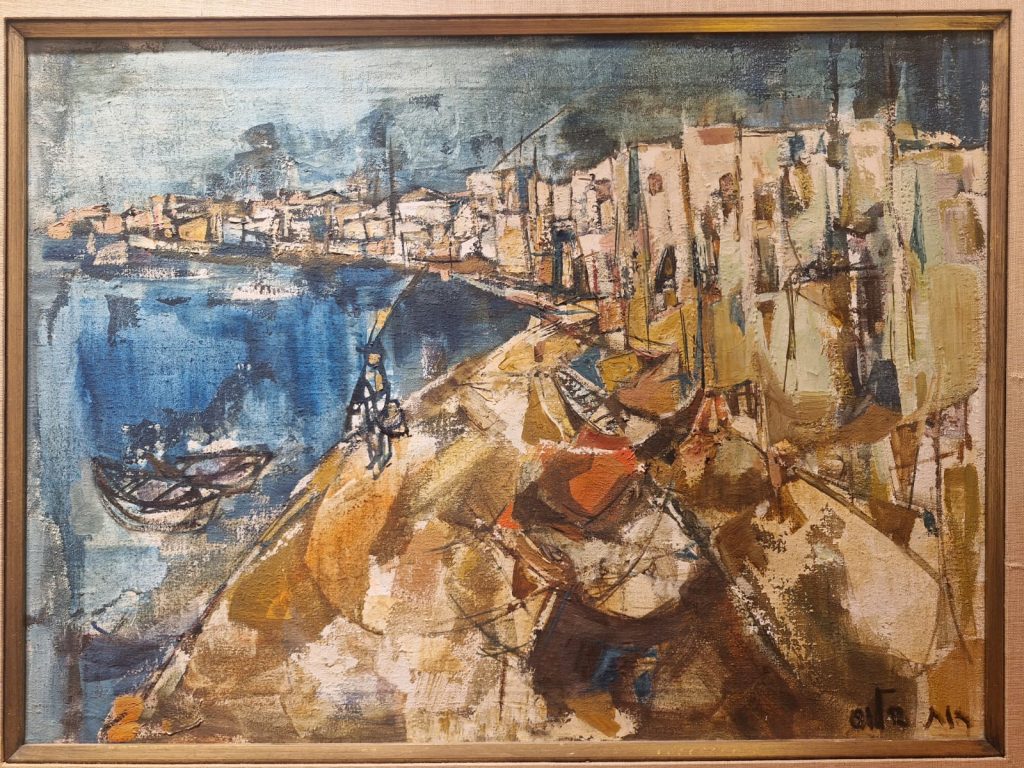
Ruth Schloss captured the landscapes and everyday surroundings of Israel through an expressive and distinctly personal artistic language. Known for her figurative paintings and drawings, she frequently explored urban environments, architecture, and the relationship between people and their surroundings. Her painting Ma’abara in Jaffa, an oil on canvas measuring 53 × 72 cm, presents a view of Jaffa’s waterfront through a combination of vibrant color, energetic brushwork, and loosely defined architectural forms.
Table of Contents
Schloss emphasizes the atmosphere of the Mediterranean coast and the visual character of the city.
Ruth Schloss and Israeli Social Realism
Born in Germany in 1922, Ruth Schloss immigrated to Mandatory Palestine in 1937. She studied at the Bezalel School of Arts and Crafts in Jerusalem and later continued her artistic education in Paris.
During the 1950s, Schloss became associated with Israeli Social Realism, an artistic approach that emphasized everyday life, social inequality, and the experiences of ordinary people. Unlike artists who increasingly explored abstraction, she maintained a strong commitment to recognizable subjects.
Moreover, her work frequently addressed poverty, displacement, and the lives of marginalized communities. Transit camps, neglected neighborhoods, women, children, and workers became recurring subjects in her paintings and drawings.
Ma’abarot and the History of Early Israel
The Hebrew term ma’abara refers to the transit camps established to accommodate large numbers of immigrants arriving in Israel, particularly during the early years of state.
The ma’abarot became an important part of Israel’s social history, reflecting both the enormous scale of immigration and the challenges of integrating new populations.
The Urban Landscape in Ma’abara in Jaffa
In “Ma’abara in Jaffa”, architecture and waterfront structures dominate the composition. Buildings extend along the right side, while a broad expanse of blue water occupies the left. Small boats, vertical poles, and irregular architectural forms establish the character of a working coastal environment.
Meanwhile, Schloss organizes the painting through strong contrasts between cool blues and warm ochres. The waterfront creates a diagonal movement into the distance, connecting the foreground with the buildings along the shore.
Her brushwork remains visibly expressive. Broad areas of paint alternate with thin, sketch-like lines, allowing architectural details to emerge without precise definition.
Furthermore, the textured surface gives the scene a sense of immediacy. Rather than describing every structure individually, Schloss captures the density and irregularity of the built environment.
The shoreline creates a diagonal movement that guides the viewer’s eye into the distance. Meanwhile, the irregular arrangement of buildings gives the urban landscape a sense of density and spontaneity.
Schloss avoids rigid architectural outlines. Instead, she suggests walls, roofs, windows, and other details through short brushstrokes and overlapping areas of paint.
The contrast between horizontal areas of water and the vertical elements of the architecture creates a dynamic visual rhythm. Boats and narrow poles introduce additional accents that connect the foreground with the distant buildings.
Jaffa
Jaffa occupied an important place in Schloss’s artistic career. From the early 1960s, she maintained a studio in the city, where its inhabitants, neglected neighborhoods, and changing urban landscape became significant subjects.
In Ma’abara in Jaffa, the absence of prominent individual figures directs attention toward the environment itself. Buildings, boats, and the waterfront become the principal elements through which the viewer encounters the city.
Our Gallery
For another perspective on the artist’s engagement with everyday life and social realities, explore Ruth Schloss’s Girl Descending the Stairs, also featured at Kings Gallery. While Ma’abara in Jaffa focuses on the urban environment, Girl Descending the Stairs places the human figure at the center, revealing another dimension of Schloss’s socially engaged artistic practice.