
Marc Chagall created a world where memory meets imagination. Musicians float between reality and fantasy, animals take on human emotions, and scenes of Jewish life appear alongside the visual language of modern European art. Few twentieth-century artists created such an immediately recognizable universe.
Born in Vitebsk in 1887, Marc Chagall carried the memories of his Jewish childhood throughout his long career. Yet Paris and the European avant-garde also transformed his art.
The engraving Le Musicien offers a particularly expressive example of this encounter. Music, memory, humor, and fantasy come together in a figure who seems to belong simultaneously to everyday life and Chagall’s imaginary world.
Marc Chagall: From Vitebsk to Paris
Growing up in Vitebsk shaped Chagall’s visual imagination. Paris opened another world. Chagall encountered Cubism, Fauvism, and other experiments of the European avant-garde after arriving there in 1910. He absorbed their bold colors and fragmented forms without abandoning figurative art.
Instead, Chagall developed his own artistic language. Reality remained recognizable, but its rules changed. Figures could fly, scale could shift, and memories could occupy the same space as present experience.
In Le Musicien, Chagall brings the musician and his double bass so close together that the figure almost merges with the instrument. The elongated body echoes its shape, turning the musician himself into part of the music. (Kings Gallery)
The image reflects Chagall’s broader interest in connecting different forms of expression. Line creates movement, repetition suggests rhythm, and the musician’s body seems to respond physically to the sound he produces.
L’Acrobate vert
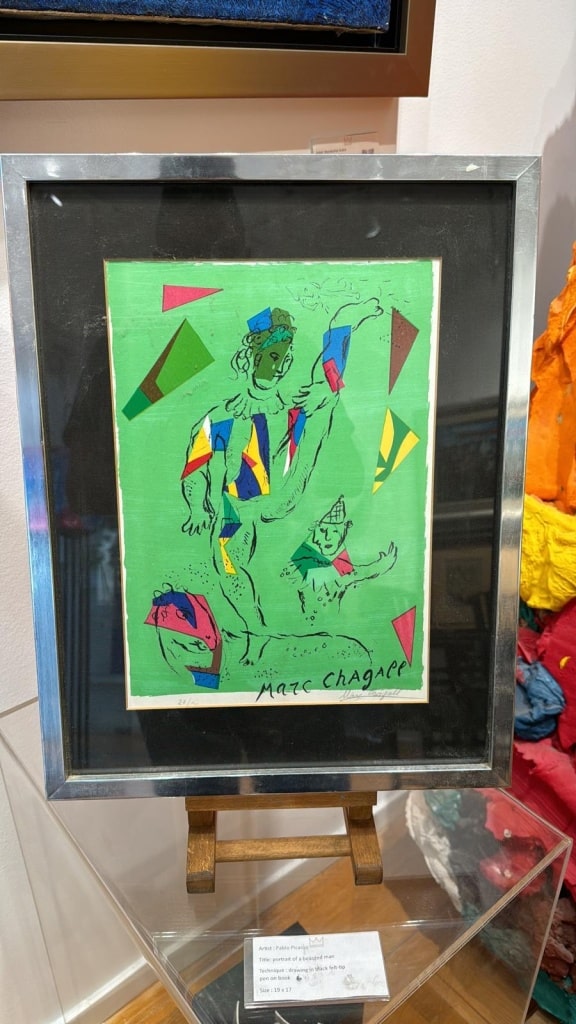
In L’Acrobate vert, the figure belongs to Chagall’s lifelong fascination with the circus — a world where gravity seems temporarily suspended and the boundary between reality and fantasy disappears. Acrobats appeared in Chagall’s art from the 1910s and became especially important after his encounters with the Cirque d’Hiver in Paris in the 1920s. For Chagall, the circus performer offered more than a colorful spectacle: the acrobat became a figure of transformation, balancing between the everyday world and another, dreamlike reality. In L’Acrobate vert, this sense of weightlessness connects naturally with Chagall’s broader visual language.
Visit Kings Gallery or contact us today to learn more about this work and other important pieces in our collection.