
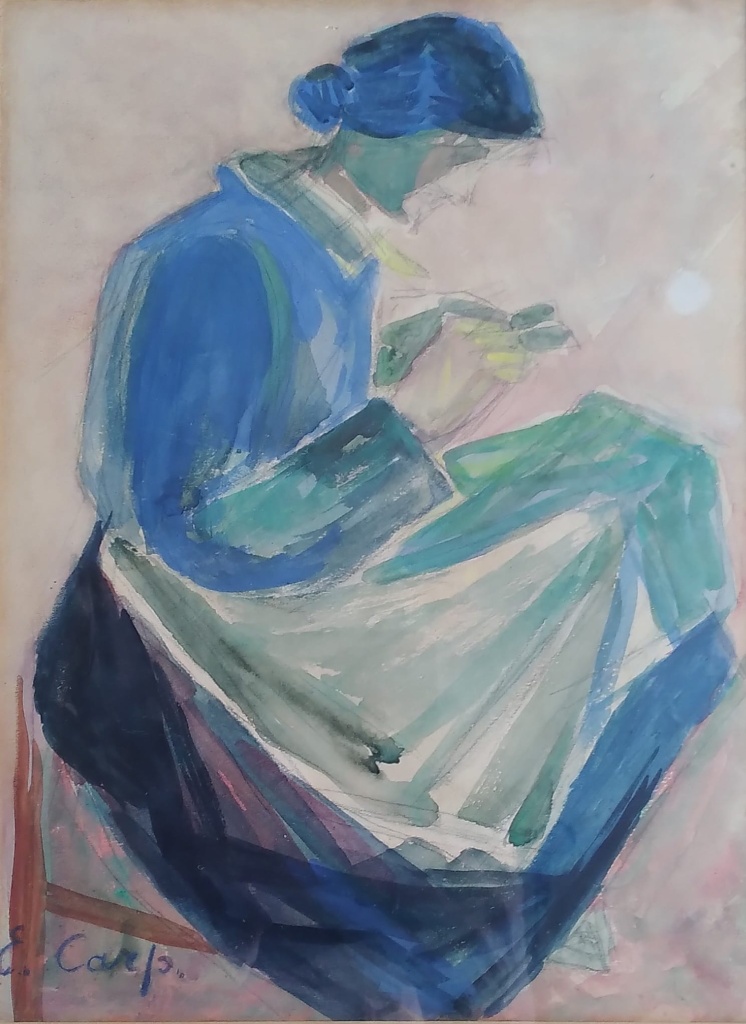
In the vibrant tapestry of the École de Paris, the work of Esther Carp (1897–1970) stands out for its unique synthesis of rhythmic composition and intimate subject matter. Her piece, “Embroiding Woman”—a watercolor and pencil on paper measuring 27 x 20 cm—is a nice example of her ability to elevate a quiet, domestic moment into a sophisticated study of form and color.
Esther Carp and the School of Paris
Born in Skierniewice, Poland, Carp moved to Paris in the 1920s, joining the ranks of Jewish artists who defined the city’s avant-garde. Unlike the grand, theatrical gestures of some of her contemporaries, Carp’s work often focused on the interior lives of women. Her style features a nervous, energetic line coupled with a bold, often Fauvist approach to color.
In “Embroiding Woman”a, Carp utilizes the 27 x 20 cm space to create a sense of concentrated interiority. The subject is depicted in a moment of deep absorption, her body contoured to the task at hand. The composition is dominated by a sophisticated range of blues and greens. The deep navy of the skirt provides a stable, weighted base for the work, while the teal and emerald washes of the garment and the fabric being worked upon create a sense of movement. The use of watercolor and pencil allows for a compelling contrast between structure and fluidity. Carp is known for her repetitive, rhythmic brushstrokes. In this piece, the angularity of the woman’s arms and the downward tilt of her head create a series of triangles that draw the viewer’s eye toward the center of the action: the needlework.
Theoretical Context
From a scholarly perspective, the motif of the “sewing woman” or “embroiderer” is a rich one in Western art history, often representing domestic virtue or feminine solitude. However, here it is more like a psychological state. The “silent” nature of the task reflects the broader aesthetic of Carp’s oeuvre, which often dealt with themes of isolation and the quiet dignity of everyday life.
Small-Scale Work
The dimensions suggest an intimate viewing experience. For Carp, this kind of works were, probably, a way to navigate the complexities of her identity as a Polish-Jewish woman in the heart of the European art world.
Kings Gallery is a leading fine art gallery established in Jerusalem in 1995. We strive to collect and sell the highest quality historic and contemporary Israeli and International art. The gallery specializes in artists from the early period of the 1920’s. In addition, Kings Gallery features leading up-and-coming young artists who will definitely be prominent names in the next few years.