
During Sukkot, we are now, Jerusalem changes, the beautiful Birkat Kohanim, the Priestly Blessing at the Western Wall attracts thousands. Thousands gather in the Old City during Chol HaMoed to hear the kohanim recite the blessing together.
Table of Contents
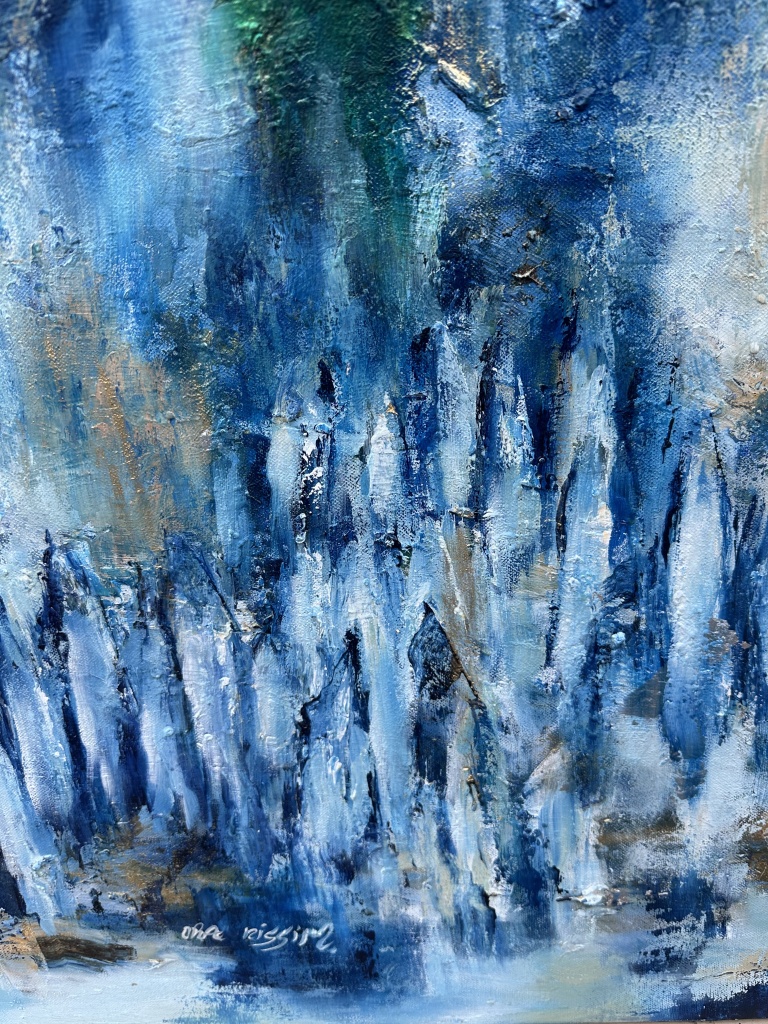
Ora Nissim’s Birkat Cohanim approaches this tradition through a very different language. Rather than documenting the ceremony realistically, the Jerusalem-born Israeli artist transforms the gathering into a field of blue, white, movement, and light.
Birkat Kohanim During Sukkot in Jerusalem
The Priestly Blessing originates in the Book of Numbers (6:24–26), where the Kohanim are commanded to bless the people of Israel.
Today, the mass Birkat Kohanim at the Western Wall has become particularly associated with Passover and Sukkot.
Moreover, Sukkot itself brings unusually large numbers of visitors to Jerusalem.
Against this background, Nissim’s painting acquires particular resonance during the festival.
Ora Nissim
Ora Nissim places contemporary Jewish experience at the center of her art. Born in Jerusalem and raised in Mea Shearim, she describes her work as an attempt to depict Judaism not simply as something belonging to the past, but as a living culture of the present and future. Her paintings frequently combine Jewish ritual, Jerusalem, prayer, and religious life with expressive color and abstraction.
That approach defines Birkat Cohanim. Instead of carefully describing individual worshippers, Nissim suggests a collective gathering through repeated vertical forms concentrated along the lower part of the canvas.
Above them, an expansive blue field dominates the composition. Layers of cobalt, ultramarine, pale blue, white, and touches of darker pigment overlap across the surface. The result lies between representation and abstraction.
Blue, Light, and the Experience of Prayer
Color carries much of the emotional force of the painting. The almost monochromatic blue palette creates unity between the figures and the surrounding space. Individual bodies remain visible, yet they also merge into the larger gathering.
Meanwhile, the upper section becomes increasingly atmospheric. Brushstrokes overlap and dissolve recognizable forms, allowing light and color to replace conventional architectural description. Nissim therefore avoids turning Birkat Cohanim into a literal illustration of a particular ceremony.
This approach corresponds closely to the artist’s broader understanding of Jerusalem. Nissim describes the city through changing atmospheres of prayer, holidays, spirituality, everyday life, and longing. For her, each day in Jerusalem possesses its own atmosphere and dominant color. Oranissim
In Birkat Cohanim, blue becomes the color through which collective prayer is experienced rather than merely observed.
Sukkot, Blessing, and a Living Jerusalem
During Sukkot, Birkat Cohanim connects especially strongly with the Jerusalem that exists beyond the canvas. Elsewhere in the city, sukkot fill streets, balconies, courtyards, and public spaces.
Nissim’s painting belongs to this living Jerusalem. Her subject comes from Jewish tradition, yet her expressive technique places that tradition firmly within contemporary Israeli art.
Ultimately, Birkat Cohanim captures something that becomes particularly visible during Sukkot: Jerusalem as a meeting point between ancient and present, individual prayer and collective gathering, physical place and spiritual experience.
Kings Gallery is a leading fine art gallery established in Jerusalem in 1995. We strive to collect and sell the highest quality historic and contemporary Israeli and International art. The gallery specializes in artists from the early period of the 1920’s. In addition, Kings Gallery features leading up-and-coming young artists who will definitely be prominent names in the next few years.